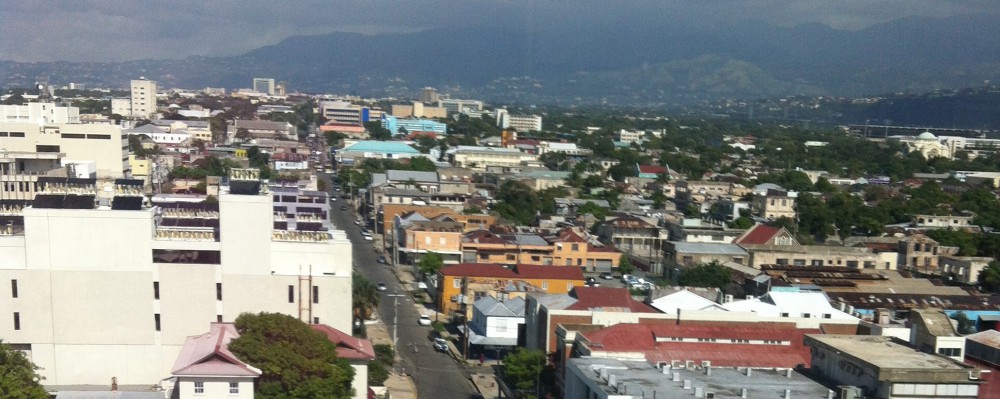
Stories about Jamaica rarely pop up in the New York Times, and if they do, they are usually related to tourism or Usain Bolt. So I was delighted to see ‘Jamaica’ in a headline in Sunday’s paper. My delight turned to disappointment, though, as I read the story.
The piece was well-written and the topic interesting: agriculture and the resurgence of a ‘back-to-the-land’ movement, but there are some serious flaws in it. Here is the lede:
KINGSTON, Jamaica — The scent of coconut oil and fiery jerk spice blows through kitchens across this green island, but as the country’s food imports have become a billion-dollar threat to finances and health, Jamaica has taken on a bold new strategy: make farming patriotic and ubiquitous, behind homes, hospitals, schools, even prisons. Across the Caribbean, food imports have become a budget-busting problem, prompting one of the world’s most fertile regions to reclaim its agricultural past. But instead of turning to big agribusinesses, officials are recruiting everyone they can to combat the cost of imports, which have roughly doubled in price over the past decade. In Jamaica, Haiti, the Bahamas and elsewhere, local farm-to-table production is not a restaurant sales pitch; it is a government motto.
Simple premise right? The cost of importing food to Jamaica is now a liability given the country’s financial challenges. Same with the rest of the Caribbean, ie Antigua and Barbuda, Haiti and the Bahamas.
As a journalist, I was immediately uncomfortable with several things: the lack of statistics, facts, background and context; the lack of sources in Jamaica (only one federal minister and a school principal) and the conflation of Jamaica with the “rest of the Caribbean” (I am sure that while there are similar problems in other Caribbean countries, the specifics of each are probably very different and conflating the entire region is problematic).
The story also opens with an example, or a case study, of one school principal who has planted a garden on school grounds to encourage local cultivation of fruits and vegetables. While it is always beneficial to have “colour”, or a case study, in a story like this, it must be backed up with other “hard” information such as statistics and history. There was little of this. (An exchange on Twitter with the reporter revealed that an editor cut a long paragraph about Jamaica’s history with structural adjustment and the IMF, which would have enhanced the story).
The lack of sources is also a problem. One or two quotes from a minister and a case study are not enough. Generalization in stories such as this are necessary, but you must back them up with an expert or observer such as a university professor who studies the topic, or someone from civil society.
Finally, it is both confusing and distracting to lump an entire region together in a story such as this one, where we get an intimate peek inside one school’s experience with the problem of expensive food imports. Why bring in other nations? Was there a conference or a study that prompted this piece? Bringing in other nations confuses the issue and encourages generalizations. Each Caribbean nation has its own intricate economy and experience with international economic bodies such as the IMF.
There was quite a reaction on Twitter to this article. Some felt it was good for Jamaica as it draws some attention to the island and its issues. Others felt it was irresponsible and assumptive.
I do not know enough about structural adjustments and the IMF to comment on specific details, but I do know that as a journalist, I would be uncomfortable submitting this story. And if I submitted a longer version and it was cut, I would fight to either save the copy or run it another day in complete form.
This is the problem with journalism. For the rapidly revolving 24/7 news cycle, it either tends towards telling a single story (which can omit important context and can encourage stereotyping) or it is overly general. Long form journalism is still alive and well, but it is not the norm in the mainstream media. (Longform pieces are long, detailed stories in which research is rich and there is a lot of background and context).
With stories where word count is not an issue, long form pieces can flourish with the greys and nuances needed for both complex issues and portrayals of people or groups. Alas, the resources of time, patience and financial backing are in short supply these days, so reporters churn out undersourced and under-researched stories. This leads to pieces in which the beginning, middle or end are lacking, or the colour is muted.
 Jamaican Journal