





Reaction to the agriculture story was mixed, with some people claiming it omitted relevant information about Jamaica’s relationship with the IMF, while others claimed any PR is good PR. I thought that while it was a good article, it did not take a broad enough view and lumped Jamaica in with the rest of the Caribbean.
Yesterday, the Times ran another story by the same reporter, who is named Damien Cave (full disclosure: I have been in touch with him trying to get him to cover some issues here in Jamaica related to some of the NGOs I’m involved with. He has responded, declining to cover these stories, claiming that he would not report on something unless he was actually in Jamaica, which is understandable.)
Yesterday’s story seemed to try to paint a balanced picture of Jamaica and its infamous crime rates. It is a relatively fair and accurate piece, I would say. The murder rate is declining, so are other criminal acts. But Jamaica still averages three murders per day, and violence is prevalent and unfortunately, does not elicit much reaction from the populace, as people are accustomed to it (this is what I hear).
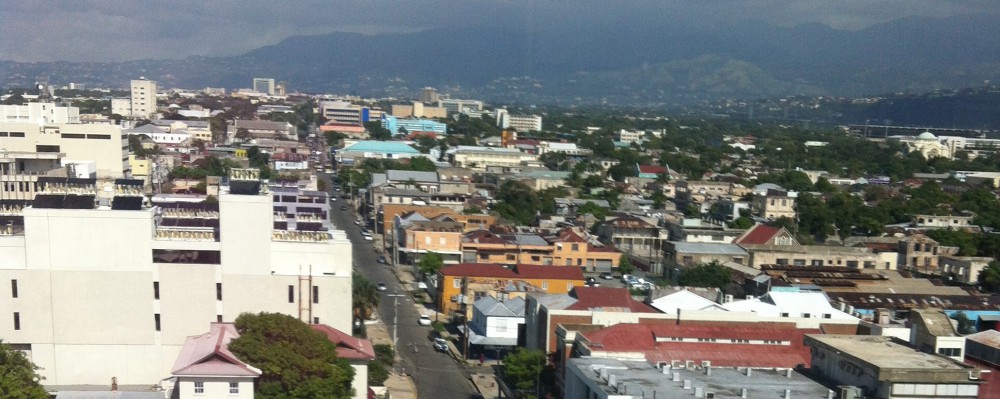
Specific to Mountain View, the community featured in yesterday’s article, the story is accurate, and I can state this based on experience. Youth Opportunities Unlimited recently completed a three-year program in this community. (We ran parenting and conflict resolution programs and worked with some of the youth on employment training). I spent some time there and never felt unsafe. We attended workshops, banquets and other events and there is a peaceful feel in the community. Children play in the streets, they are shepherded to their homes by neighbours when darkness falls, and everyone knows and looks out for one another. At least it seemed this way whenever I was there.
As the story states, there has not been a murder in Mountain View for three years. Prior to this time, different groups were warring with each other and shootings and curfews were common. It should be mentioned, however, that a young man named Kavorn Shue was killed by police last year, and this incident is still under investigation. (It should also be noted that while the murder rate is falling, Shue’s death is part of a disturbing island-wide phenomenon: 127 Jamaicans have allegedly been killed by police so far in 2013.)
Of course, a news article with a word-count limit cannot tell the whole story. One of the times I was there, in March, a woman told me violence (not murders, however) is still occurring. She told me a group of men attacked some of her family members with a knife. I could not verify this, but I got the sense that some conflicts are still not resolved in the community. I imagine a fulsome report on Mountain View and its history of violence and crime would be a long one, a book perhaps. Too long for the average person to commit to, too long for a reporter to spend there, researching and writing. And isn’t this true of every story, every individual, every community, every nation?
All this to say, I am puzzled, and slightly disillusioned lately when it comes to the ability of journalism to portray an entire, accurate story. Is it even possible to tell the whole story, to not adopt a slant or an angle? Yes, crime in Jamaica is declining, but violent acts take place every day and an average of three people per day are murdered. Yes, one community has made strides in reducing the murder rate, but dozens of other communities are only becoming more volatile.
I don’t have the answer as to journalism’s role and responsibility as it relates to reporting on serious issues such as crime and violence and human rights. I do know that to do an adequate job, a reporter would have to spend a lot of time in a community, in a country, to understand all the nuances of its culture. Time, unfortunately, is a finite resource, as is the financial backing required to truly get to know an area. This is especially true as the journalism business undergoes massive seismic shifts in its business model. And do people even commit the time to read the long, fleshed-out stories that would be necessary to accurately portray complex situations?
So we are left with reports that lack nuance, context, background and history. We are left with social media reports, two-minute radio and television reports and stories by reporters who drop in and out of communities and writing pieces without a full understanding of their topics and subjects. This is not in the public interest but perhaps as the business continues its shake-up, a new model will emerge. Let’s hope so. Let’s hope that the new model tells as much of the story as possible.
 Jamaican Journal