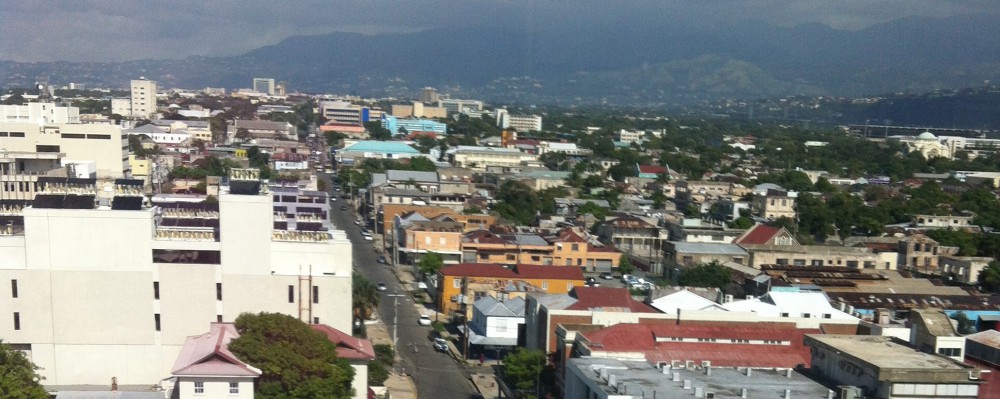
I don’t know what this Foreign Policy journalist was thinking. Maybe he was having a rough day, or maybe he was up against deadline and just desperate for a lead. Because he led a story with the fact that the “good news” that the Jamaican bobsled team received funding to go to the Olympics via an Internet campaign is somehow a balm for the fact that ONE THOUSAND, TWO HUNDRED people were murdered in 2013 in Jamaica.
Consequently, it’s refreshing to hear some good news about the country. After Jamaica’s two-man bobsled team announced that it had qualified to compete in the 2014 Winter Olympics but could not afford to travel to Sochi, Russia, thousands of people contributed to an Internet crowdfunding campaign. In just three days, the campaign raised $129,587 — more than 12 times the amount needed to fund the team’s travel.
And here is the lead paragraph, by the journalist, who is called Robert Looney, and whom I wonder about: has he ever spent any time in Jamaica?:
It’s easy to be pessimistic about Jamaica. The country has the world’s highest debt burden, and its economic growth has been at a near standstill over the past several decades. It has been plagued by rising levels of violence and crime, with one of the highest murder rates in the world — 1,200 murders or 44.2 per 100,000 inhabitants in 2013, a 9.4 percent increase over 2012.
As evidence of Jamaica’s turnaround and a plethora of good news, Looney also points to the fact the the country is on track to meet the conditions of the financial agreement with the International Monetary Fund. In essence, the IMF is lending Jamaica a whole bunch of money so that it can tackle its staggering debt-to-GDP ratio, among other financial ills.
On paper, there may indeed be good things happening. On the ground, I am not so sure. Crime levels remain high. Roads remain unfixed. Inflation and poverty levels are rising. Jamaica’s children are not being educated properly. And as the IMF exerts its influence, conspiracy theories abound and trust in international institutions and the U.S. is weak.
Case in point, the massive rally against the “gay agenda” a couple of weeks ago, which was organized by a coalition of churches. From columnist Ian Boyne’s article:
The Church must maintain its right to teach that homosexuality is sinful, abominable, morally degrading and hell-certifying. I know gay people resent my saying that. They do want to have that categorised as hate speech and censored. They do want it to be seen in the same category as racist speech. And I know that my libertarian view on free speech will increasingly be resented and rejected. That’s why I know Christians are fighting an uphill battle against “principalities and powers”. The US, Europe and their multilaterals will soon demand that gay rights be subsumed under human rights, the denial of which will make us ineligible for financial support.
People are also pointing to the mysterious resignation of former Police Commissioner Owen Ellington, claiming that U.S. officials pressured National Security Minister Peter Bunting to force him out early as a result of the high instances of extrajudicial killings.
But back to the article. The bulk of it is a solid portrayal of Jamaica’s recent economic history and relationship with the IMF. But then the conclusion takes a solid turn for the worse. Looney returns to Internet crowd funding as a potential source of hope for Jamaica.
Fortunately for Jamaica, the world economy, finance, and transport are all shifting in ways favorable to the island nation. As the bobsled team demonstrated, crowdfunding is a new force that could significantly offset the austerity program by enabling cash-strapped Jamaican entrepreneurs to develop new small- and medium-sized enterprises.
And then Looney points to a large-scale industrial Chinese development initiative, as well as access to international supply chain markets, as opportunities for this nation:
In addition, Jamaica is also very favorably placed to take advantage of the opportunities opening up with the shift of many American company supply chains from Asia to locations closer to the United States. Finally, with the expansion of the Panama Canal to be completed in 2015, Jamaica is ideally positioned to develop into a major logistics hub. If undertaken, the project would be a major attraction to follow-on investment and production.
If Looney were to ask those on the ground, environmentalists, ordinary Jamaicans, entrepreneurs, he might find them not so optimistic. The lack of context, and reality, is breath-taking. This article is an irresponsible and skewed portrayal of Jamaica.
 Jamaican Journal