Link


Premiere of 18 Degrees North

The premiere episode of 18 Degrees North aired last night on TVJ. It will be online on Thursday at 9pm. The first episode featured a compelling interview with Lee Boyd Malvo, who was born in Jamaica. He was convicted of murder in the D.C. sniper killings, along with John Allan Muhammad. The pair were deemed serial killers and Malvo is now serving life a sentence, while Muhammad was executed.

Last night’s interview was conducted by host Zahra Burton and was particularly revealing when Malvo discussed the lack of attention paid to him by his father. The story also featured an interview with University of West Indies Professor Herbert Gayle, who spoke about the lack of father figure role models for Jamaican boys. As well, Burton talked to Malvo’s father, who disputed his son’s claim that he was not a good father.

Of course, it is impossible to prove causality for such a case as this, but there is no doubt that generations of boys suffer from a lack of parenting, and not only by their fathers.

Keep an eye out for the story online, it is worth watching. Also keep an eye out for my piece on children in the adult prison system, airing in the next few weeks.

Kriativ Aktivis Randy McLaren Performs at YOU Function

Video


Some days, there is an excess of depressing news here. Too many killings, too much poverty, too many people in need. It can get to you, depending what you choose to focus on. So here is a positive story on a Monday morning for you:

Randy McLaren, otherwise known as the Kriativ Aktivis, was a Youth Opportunities Unlimited mentee when he was in high school. Here is what he said about how the experience benefited him:

“I was a mentee. Received all the training in things a peer counsellor should know. I developed sound life skills, became a better listener and was better able to assist my peers as a student leader. I also expressed the new knowledge via my creative talents. I was able to hone my skills as a positive change agent. Empowerment is key.”

Randy is now forging a successful path in the performance/entertainment industry. Check him out in this video performing at a recent YOU function.

I know from firsthand experience the benefits of the mentor/mentee relationship, having mentored several young people over the years. The cliche is true, I think, that it enriches the mentor more than the mentee. So it is nice to hear about the benefits from the other side of the equation, too. Have a great day!

Is Jamaica fighting to break grip of violent past?


So claims a New York Times article by the same fellow who recently wrote this article about agriculture in Jamaica. It’s not often the New York Times, or any other major international media outlets, for that matter, focus on Jamaica. If they do, their coverage is usually limited to tourism or major crime, such as the murder of young Imani Green.

Reaction to the agriculture story was mixed, with some people claiming it omitted relevant information about Jamaica’s relationship with the IMF, while others claimed any PR is good PR. I thought that while it was a good article, it did not take a broad enough view and lumped Jamaica in with the rest of the Caribbean.

Yesterday, the Times ran another story by the same reporter, who is named Damien Cave (full disclosure: I have been in touch with him trying to get him to cover some issues here in Jamaica related to some of the NGOs I’m involved with. He has responded, declining to cover these stories, claiming that he would not report on something unless he was actually in Jamaica, which is understandable.)

Yesterday’s story seemed to try to paint a balanced picture of Jamaica and its infamous crime rates. It is a relatively fair and accurate piece, I would say. The murder rate is declining, so are other criminal acts. But Jamaica still averages three murders per day, and violence is prevalent and unfortunately, does not elicit much reaction from the populace, as people are accustomed to it (this is what I hear).

Specific to Mountain View, the community featured in yesterday’s article, the story is accurate, and I can state this based on experience. Youth Opportunities Unlimited recently completed a three-year program in this community. (We ran parenting and conflict resolution programs and worked with some of the youth on employment training). I spent some time there and never felt unsafe. We attended workshops, banquets and other events and there is a peaceful feel in the community. Children play in the streets, they are shepherded to their homes by neighbours when darkness falls, and everyone knows and looks out for one another. At least it seemed this way whenever I was there.

As the story states, there has not been a murder in Mountain View for three years. Prior to this time, different groups were warring with each other and shootings and curfews were common. It should be mentioned, however, that a young man named Kavorn Shue was killed by police last year, and this incident is still under investigation. (It should also be noted that while the murder rate is falling, Shue’s death is part of a disturbing island-wide phenomenon: 127 Jamaicans have allegedly been killed by police so far in 2013.)

Of course, a news article with a word-count limit cannot tell the whole story. One of the times I was there, in March, a woman told me violence (not murders, however) is still occurring. She told me a group of men attacked some of her family members with a knife. I could not verify this, but I got the sense that some conflicts are still not resolved in the community. I imagine a fulsome report on Mountain View and its history of violence and crime would be a long one, a book perhaps. Too long for the average person to commit to, too long for a reporter to spend there, researching and writing. And isn’t this true of every story, every individual, every community, every nation?

All this to say, I am puzzled, and slightly disillusioned lately when it comes to the ability of journalism to portray an entire, accurate story. Is it even possible to tell the whole story, to not adopt a slant or an angle? Yes, crime in Jamaica is declining, but violent acts take place every day and an average of three people per day are murdered. Yes, one community has made strides in reducing the murder rate, but dozens of other communities are only becoming more volatile.

I don’t have the answer as to journalism’s role and responsibility as it relates to reporting on serious issues such as crime and violence and human rights. I do know that to do an adequate job, a reporter would have to spend a lot of time in a community, in a country, to understand all the nuances of its culture. Time, unfortunately, is a finite resource, as is the financial backing required to truly get to know an area. This is especially true as the journalism business undergoes massive seismic shifts in its business model. And do people even commit the time to read the long, fleshed-out stories that would be necessary to accurately portray complex situations?

So we are left with reports that lack nuance, context, background and history. We are left with social media reports, two-minute radio and television reports and stories by reporters who drop in and out of communities and writing pieces without a full understanding of their topics and subjects. This is not in the public interest but perhaps as the business continues its shake-up, a new model will emerge. Let’s hope so. Let’s hope that the new model tells as much of the story as possible.
Forty per cent unemployment


“DESPAIR”

This is the lead-in to an article in the Jamaica Observer today. Normally, I do not advocate such dramatic language, but I think it is accurate in this case. The latest overall unemployment rate (from April 2013) sits at 16.3 per cent, and 38.5 per cent for youth aged 14-24.

According to STATIN (Jamaica’s governmental statistics department), the unemployment rate increased from April 2012 to April 2013:

The number of Unemployed persons in April 2013 was 215,100. This was an increase of 30,200 (16.3%) when compared with 184,900 in April 2012.

The number of unemployed males increased by 9,500 (12.4%) and the number of females by 20,700 (19.1%) for the same period.

The Unemployment Rate for April 2013 was 16.3% compared to 14.4% in April 2012. For the same period, the unemployment rate for males was 12.0% compared to 21.3% for females.

The press release is slightly confusing, but it appears that the increase in unemployment is due to an increase in entrants to the labour force who were unable to find employment.

The incremental increase in the unemployment rate for the April 2013 Labour Force Survey was caused by an additional 38,900 (3%) new entrants to the labour force. Of these additional entrants only 8,700 (0.8%) found employment which resulted in 30,200 (16.3%) persons being unemployed.

Overall, Jamaica’s labour force tops out at 1,322,500, which is an increase of three per cent from April 2012. Broken down by males and females,

The male labour force increased by 15,600 (2.2%), from 700,500 in April 2012 to 716,100 in April 2013, and the female labour force increased by 23,300 (4.0%) moving from 583,100 to 606,400 in the same period.

Looking beyond the numbers, the most alarming trend is youth unemployment (Youth Opportunities Unlimited will be hosting a Twitter discussion on this topic on Wed., Aug. 21 at 1 p.m. We will be joined by Dr. Andre Haughton, who wrote this article on employment in the Jamaica Gleaner. It is worth a read, and please join in the discussion using #youthunemploymentJA).

Here is an excerpt from the article, explaining briefly the reason for Jamaica’s unemployment:

This cyclical unemployment is associated with changes in the business cycle, as economic conditions worsen, people’s demand for goods and services fall, firms respond by reducing production and lay off workers.

Currently in the Jamaican economy, there are more people willing to work than the number of jobs available, and if economic conditions continue to worsen, more and more firms will continue to lay off workers, and cyclical unemployment will continue to increase.

Without the expertise of an economist, it is difficult to understand, but intuitively, I would surmise that Jamaica’s population skews young. Many of these youths do not have the education or training they need to be employable, so they are unable to enter the official labour force. Many of them take “off-the-books” jobs, such as selling fruit on the roadside.

I know of at least one young man who is affiliated with YOU who, every week, hands delivers dozens of resumes to companies who may or may not be hiring, to no avail. It is so discouraging for him and so many other youths. They just want to work, they tell us. But when it comes to employment, it is a seller’s market right now.

The government engages in training programs, while the private sector runs internship programs to help youth enter the workforce, but it is not enough. Jamaica’s economy must show growth, consumer confidence must return and people must start spending money again so that companies begin hiring. In the meantime, Jamaica’s youth face the depressing prospect of remaining out of work.

Father Charles Brown murdered


Earlier this week, a woman from the U.K. named Sabrina contacted me, asking for help related to the murder of her relative, Father Charles Brown. The 71-year-old priest was murdered in a community close to Kingston. There are suspects. Sabrina asked me to run this letter on my blog (it also appeared in local newspapers), so I oblige here, with hopes it will help somehow.

Dear People of Jamaica,

We are the family of Father Charles Brown, lovingly known to many as ‘Uncle Charles’.

On the 24th July the senseless murder and loss of our beloved brother, uncle and servant of God, Father Charles Brown has sent ripples of pain and heartache across oceans and continents.

To us ‘Uncle Charles’ was a vibrant and funny man, he really loved a good joke, very understanding and adored animals, he devoted his life to the service of others, often sacrificing his own needs.

Uncle Charles was known to go without food or sleep in order to provide support and comfort to families in grief, to be a character witness for those facing the courts or to joyfully perform the baptism of a baby, welcoming them into the world with his kindness and warm smile.

He spent his life giving from his heart and we have had him brutally ripped from ours.

In every sense of the word Uncle Charles was a loving nurturing man who was not just a religious Father but a ‘father figure’ to many, in particular the disaffected youth with no positive male role models in their lives. He was the kind of person who would listen to your troubles without passing judgement or breaking your confidence.

One member of our family spoke to him on the day before his disappearance and recalls that the last words said were, “I love you” to which he replied “I love you more” this loving exchange was not uncommon when speaking to Uncle Charles, he was a very caring man.

So, it is with deep, deep sadness that his life was so cruelly taken in such a violent way.
As a family we do not want revenge, there is already too much blood-shed within our communities. We do however, want the person or persons responsible to have their day in court, look us in the eye and try to justify their motive for causing such deep pain and sorrow to the family of a defenceless old man, who would probably have helped them, if only they had asked.

What could he possibly have done to cost him his life?

We are very grateful to the Jamaican police force for all their hard work and countless hours trying to piece together what happened to ‘Uncle Charles’ since his disappearance last Wednesday and their swift action in trying to locate suspects.

Thank you to the Roman Catholic Church community, for their amazing support and assistance to our family and local communities, we acknowledge that they are also feeling the effects of uncle’s sad loss.

Thank you also to the Press for their local and international coverage of our plight; and for publishing the appeal for information surrounding the whereabouts of potential suspects and leads. We hope you will continue to help us.

We are also grateful to you the wonderful, caring people of Jamaica and around the world for your continuing messages of support and condolences that we have received. . They have been a tremendous source of comfort to us.

Thank you for your support.
The heart broken Family of Father ‘Uncle Charles’ Brown
August 2nd 2013

Developing Curriculum and Capacity for Sex Education


I must share this blog today. It is an insightful look at sex education in Jamaica and Ontario by Jason, a YMCA intern from Toronto. His time is coming to a close here in Jamaica and us volunteers have enjoyed getting to know him. Also, you should know that the Canadian government is poised to kill off funding for the internship program that sent Jason down here. Good luck Jason, you have done some wonderful work and we will miss you!

Rain a fall


Rain a fall, as Jamaicans say. It has been raining since early this morning, when I set out with a couple of running group friends. We tackled the hill in 8-Mile and it was sprinkling as we started. My fellow runners, Jamaicans, were hesitant to run in the rain. I laughed as I told them that I’ve run in blizzards, hail, sleet, what have you. By the end of the run, it was full on raining, and they claimed my culture is now rubbing off on them.

The rain did not limit the turnout for my next event, the release of an exciting report by fellow Cuso volunteer Erin on her gender research. To be specific, Erin researched the concept of “gender mainstreaming” and how it can be incorporated into all facets of Jamaican life. It was very interesting and prompted a lively discussion amongst attendants, who were mostly women and mostly from civil society.

These pictures were taken last week at Devon House upon the departure of Stefanie, a delightful intern from Germany. She was with YOU for the past few months doing research for her university course. She was also an invaluable help to me as I worked on my television report. We already miss her. Check out the cute keychain she had made for us!

Bolt to the rescue?


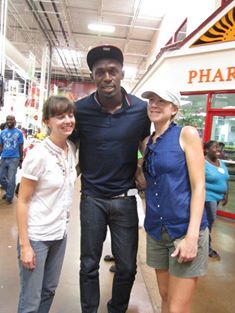
For short stints over the past two days, the island has gone quiet as everyone watched their track and field heroes compete in Moscow. Usain Bolt regained his 100m title yesterday, while Shelly Ann Fraser Pryce did the same today. This is a picture of me and Brianna meeting Bolt at MegaMart last year, right after the Olympics. Note the ridiculous grin on Brianna and the googly eyes on me. He was very gracious with us and all the other fans.
Brianna, Bolt and me

Secret Garden


There are very few quiet places in Kingston, what with music, cars, conversations and a full vocabulary of car-horn language. So people carve out their own little oases, if they can afford it. I have been walking the dogs for my friend down the street from me. She lives in an unsuspecting-looking townhouse that opens out to a stunning backyard and garden. It is captivating. She also keeps bees there and has installed a fountain you can lie about in on hot days.

There are also pictures of some stray dogs she feeds up in Armour Heights, where the view is spectacular. Enjoy your Sunday, and please check out this link to the Toronto Star story. The reporter Jennifer Quinn did a wonderful job. She told me she was very nervous about it, but I think she wrote a fair and balanced piece. It will be interesting to see how Jamaicans react.

Toronto Star comes to Kingston


Awhile back, I contacted the Toronto Star’s newsroom about a young man named Javed Jaghai. He is challenging Jamaica’s buggery law, which makes some sexual activities illegal.

An editor bit, and they ended up sending down reporter Jennifer Quinn for a few days. There is a video report, and I believe there is a print story as well, but it doesn’t seem to be online. I think she created a fair, balanced piece. There was some concern from Mr. Jaghai about how she would portray his story, but they sorted it out after some dialogue. Having been here awhile now, I see how different foreigners’ perceptions are of Jamaica, how many stereotypes there are, and how hard people have to fight to be seen as individuals. It takes a lot of mental work to push past our own perceptions and pre-conceived notions. Stories such as Jennifer Quinn’s help. Check it out here.