18 Degrees North

Video


Check the promo for the new news magazine I am working with, 18 Degrees North. It is launching next week and my story will air soon. 18 Degrees North intends to be a 60 Minutes-type investigative show that will be aired on Jamaica’s TVJ channel and eventually elsewhere in the Caribbean. Its anchor, Zahra Burton is a former Bloomberg Television (and former Miss Jamaica) reporter who worked out of New York City.

A homeless man polishes his shoes


The effects of poverty are prominent in Kingston. Homeless people sleep on the streets of the corporate area and downtown. Children sell chocolate bars when they should be in school. People live in abandoned buildings and squat and rejig power lines to access free electricity. People ask for money regularly. And that is just what we see as we walk and travel about Kingston.

Being a regular witness to poverty engenders many reactions among people, depending on the person, the time of day, their mood or any number of other variables, I think. People can tune it out or they can continue to feel heartbroken, angry, bewildered and confused about how to respond.

I know that for me, my reaction depends on the day and the circumstances, but it is never easy to see or to know what the “appropriate” response is. Lately, however, I have been realizing that everyday, when it comes to poverty, I see at least one thing that challenges me, prompts me to stop and question my expectations and assumptions.

In less vague, euphemistic terms, when I see the people I assume are homeless, or at the very least poor enough to need to ask for money, I assume they are unhappy. I guess I dehumanize them by detracting in my mind their capacity for a full range of emotions such as joy, dignity and happiness. Here are some recent scenes that have caused me to check myself.

A homeless man, wearing ragged clothing, surrounded by a several plastic bags of odds and ends, sitting on a wall on Hope Road, early in the morning, polishing his shoes.

A young man, in a merino tank top, backwards cap, ragged shorts and no shoes, sweating as he wipes people’s car windshields at the intersection of Hope and Trafalgar Roads for the equivalent of several dollars per wipe, breathing in exhaust fumes and listening to people reject his advances all day, dancing on the median to music only he can hear.

An elderly man who literally sits in a cardboard box all day, arms and legs dangling out the sides, wearing pants and a long-sleeve shirt, smiling and greeting passersby, not asking for any money, while his peers beside him ask for “a twenty dollar fi buy some food.”

I have seen these three scenes repeatedly, and they have caused me to think, a lot, and for that I am grateful.

The Children’s Oasis needs help


I first met Moira Morgan a couple of months ago for a story I am researching. She is a delightful Irish-born woman who has been in Jamaica for decades. She has a big heart that clearly holds her many feelings close to the surface, and that generosity and sensitivity has lead her to come to the aid of many Jamaicans over the years. I interviewed Ms. Morgan for a story I am working on about children in the prison system.

Ms. Morgan has worked with many Jamaicans who have fallen through the country’s social safety net, including young women who survived the horrible fire in Armadale (a correctional facility). On the day of our interview, Ms. Morgan was joined by one of the Armadale survivors and their bond was unmistakable. So were the tears that threatened to spring from Ms. Morgan’s eyes during the interview. It takes a strong person to engage in any type of work that involves helping people who may need extra assistance, for whatever reason. Ms. Morgan is clearly strong, having worked in some of Jamaica’s toughest inner-city communities. She told me about working in those communities, about bringing together dons and young men to find peaceful resolutions. About young men who went from holding guns to teaching children how to read.
In her own words, here she is talking about her work in that commumity:

What haunted me most was the sound of children crying. Their heart wrenching cries constantly being heard above the sounds of gospel singing churches, raucous dance hall djs and the nightly barrage of gunshot.

Ms. Morgan founded the Griffin Charitable Trust, which over the years has done the following:

education and literacy programmes have been established. Refuge and safe havens have been provided for young children, girls fleeing sexual predation and for women fleeing domestic violence. Other projects undertaken have included gang mediation programmes and care for the elderly.

Ms. Morgan has just embarked on an indidgogo.com fundraising campaign aimed at buying a house and plot of land. Dubbed The Sanctuary, the house will be a place to live for more than a dozen children and elders who have no other place to go. It is located in Kingston’s Eastern parish of St. Thomas (Whitehorses to be specific). Digicel has already committed $60,000 US and $50,000 more is required to cover things such as legal costs, land and related expenses.

The house is intended to be an oasis for residents, as well as a safe space in which families can reintegrate with one another once they have experienced the cycle of violence (they estimate 600 people per year will pass through). This is an indiegogo campaign, which is a “crowdfunding” project. There is a time limit on the campaign, and people who make a donation (depending on the amount) will receive something in return, such as a rock dedicated to them in the Corner Stone rock garden that is planned for the grounds.

Check out the campaign here and spread the word if you cannot donate.

Happy Independence Day Jamaica!


A year ago, Jamaicans were in a frenzy, celebrating 50 years of independence, Emancipation Day and the Olympics. It was an exciting time to be here. This year seems more subdued, understandably. Fifty-one is not quite as remarkable as half a century, I guess.

Jamaica is a beautiful nation, in many aspects. Physically, to be sure, but also spiritually. The resilience, courage, passion and creativity of its people is remarkable. I have been enriched by living here in many, many ways, and I’m sure most foreigners would agree.

However, violence and economic insecurity remain plagues on the nation’s health, but considering this nation’s history and the reality that 51 years is young for a nation, the country’s future is bright if it can tap into the rich resource that is the spirit of its people.

Happy Birthday Jamaica!

To this end, Prime Minister Portia Simpson Miller has released a quite beautiful Independence Day speech.
Here is an excerpt, and check out the rest here:

At this stage of the journey, it is fitting to ask ourselves as Norman Manley did in his time, “What is the mission of this generation? It is…tackling the job of reconstructing the social and economic society and life of Jamaica.

Our mission must take us briskly along the path of economic growth and national development.

Let us reconstruct our society so that all Jamaicans can meaningfully participate in the economic life of the nation.

Let us ensure that every Jamaican is accorded respect and feels a sense of belonging to our society.

Let us give full expression to the words of our Motto “Out of Many One People” as we celebrate the blending of our races and cultures and their contribution to nation building.

Let us remember that Jamaica is more than a brand, more than a name, it is the pride of a people.

Let us work towards creating a just, equitable, harmonious, productive and confident people.

We are the masters of our destiny. The future lies in our hands. We must treasure our independence by working together to build a strong economic foundation and a prosperous nation for all Jamaicans.

As Norman Manley told us “…out of the past far away and the past near at hand is born the present, in which a people coming to maturity and nationhood can look back and give praise, look around and give thanks, look forward with prayer and in humility but with confidence and strength.

Can you avoid the single story?


Stories about Jamaica rarely pop up in the New York Times, and if they do, they are usually related to tourism or Usain Bolt. So I was delighted to see ‘Jamaica’ in a headline in Sunday’s paper. My delight turned to disappointment, though, as I read the story.

The piece was well-written and the topic interesting: agriculture and the resurgence of a ‘back-to-the-land’ movement, but there are some serious flaws in it. Here is the lede:

KINGSTON, Jamaica — The scent of coconut oil and fiery jerk spice blows through kitchens across this green island, but as the country’s food imports have become a billion-dollar threat to finances and health, Jamaica has taken on a bold new strategy: make farming patriotic and ubiquitous, behind homes, hospitals, schools, even prisons. Across the Caribbean, food imports have become a budget-busting problem, prompting one of the world’s most fertile regions to reclaim its agricultural past. But instead of turning to big agribusinesses, officials are recruiting everyone they can to combat the cost of imports, which have roughly doubled in price over the past decade. In Jamaica, Haiti, the Bahamas and elsewhere, local farm-to-table production is not a restaurant sales pitch; it is a government motto.

Simple premise right? The cost of importing food to Jamaica is now a liability given the country’s financial challenges. Same with the rest of the Caribbean, ie Antigua and Barbuda, Haiti and the Bahamas.

As a journalist, I was immediately uncomfortable with several things: the lack of statistics, facts, background and context; the lack of sources in Jamaica (only one federal minister and a school principal) and the conflation of Jamaica with the “rest of the Caribbean” (I am sure that while there are similar problems in other Caribbean countries, the specifics of each are probably very different and conflating the entire region is problematic).

The story also opens with an example, or a case study, of one school principal who has planted a garden on school grounds to encourage local cultivation of fruits and vegetables. While it is always beneficial to have “colour”, or a case study, in a story like this, it must be backed up with other “hard” information such as statistics and history. There was little of this. (An exchange on Twitter with the reporter revealed that an editor cut a long paragraph about Jamaica’s history with structural adjustment and the IMF, which would have enhanced the story).

The lack of sources is also a problem. One or two quotes from a minister and a case study are not enough. Generalization in stories such as this are necessary, but you must back them up with an expert or observer such as a university professor who studies the topic, or someone from civil society.

Finally, it is both confusing and distracting to lump an entire region together in a story such as this one, where we get an intimate peek inside one school’s experience with the problem of expensive food imports. Why bring in other nations? Was there a conference or a study that prompted this piece? Bringing in other nations confuses the issue and encourages generalizations. Each Caribbean nation has its own intricate economy and experience with international economic bodies such as the IMF.

There was quite a reaction on Twitter to this article. Some felt it was good for Jamaica as it draws some attention to the island and its issues. Others felt it was irresponsible and assumptive.

I do not know enough about structural adjustments and the IMF to comment on specific details, but I do know that as a journalist, I would be uncomfortable submitting this story. And if I submitted a longer version and it was cut, I would fight to either save the copy or run it another day in complete form.

This is the problem with journalism. For the rapidly revolving 24/7 news cycle, it either tends towards telling a single story (which can omit important context and can encourage stereotyping) or it is overly general. Long form journalism is still alive and well, but it is not the norm in the mainstream media. (Longform pieces are long, detailed stories in which research is rich and there is a lot of background and context).

With stories where word count is not an issue, long form pieces can flourish with the greys and nuances needed for both complex issues and portrayals of people or groups. Alas, the resources of time, patience and financial backing are in short supply these days, so reporters churn out undersourced and under-researched stories. This leads to pieces in which the beginning, middle or end are lacking, or the colour is muted.
Could this work in Jamaica?

Video


This 60 Minutes story aired a few months ago and again tonight. It got me thinking then and now. The story outlines the experiences of an American Green Beret soldier who served in Iraq. This soldier drew up a plan to tackle drug and gang violence in Springfield, MA that is based on counter-insurgency principles.

I don’t know enough about counter-insurgency to comment on its merits, but I do know that it has had mixed results in the Middle East. Basically, it involves creating a heavy and visible police presence in neighbourhoods. What also stood out to me was the weekly elder meetings, which invited people from civil service organizations, schools, residents, business-owners, or anyone with an interest in safety, to meet every week to discuss whatever needed to be addressed.

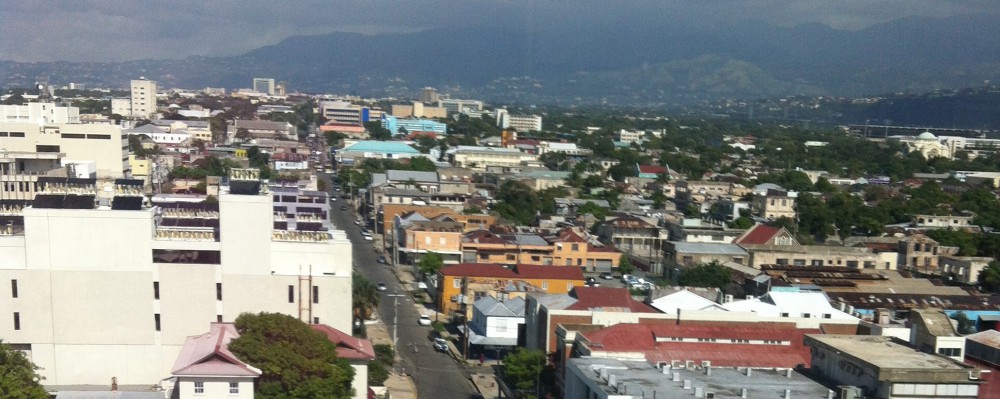
I wonder if this would work in Jamaica. Certainly, gang violence is a major issue. It takes lives and creates fear, which has countless ripple effects in the community.

In general, dialogue usually eases conflict, but I wonder if the dons and drug dealers in Jamaica would be open to such a program. First, however, the police would have to regain the trust of the communities.

In any case, this is worth a watch as it is thought-provoking and an interesting thought experiment to apply to communities affected by gang and drug violence.

Boston


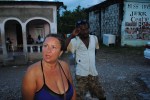
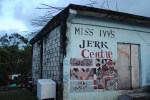
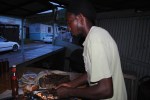
The north coast, Boston Bay.

Happy Emancipation Day Jamaica!


Happy Emancipation Day Jamaica!

This is the man with the golden voice, Richie Stevens, doing the national anthem. Enjoy!