Happy Thanksgiving!


Happy Thanksgiving to my American friends, family and readers. What are you grateful for? This is my 99-year-old grandmother driving a golf cart on an abandoned airport strip. She has not been able to drive for at least a decade, and it was something she so loved. She misses driving all the time, but she can still drive this golf cart. Her smile is never so big, she is so grateful, when she can feel the freedom this gives her. It is a beautiful thing.

Trench Town Reading Centre celebrates 20 years


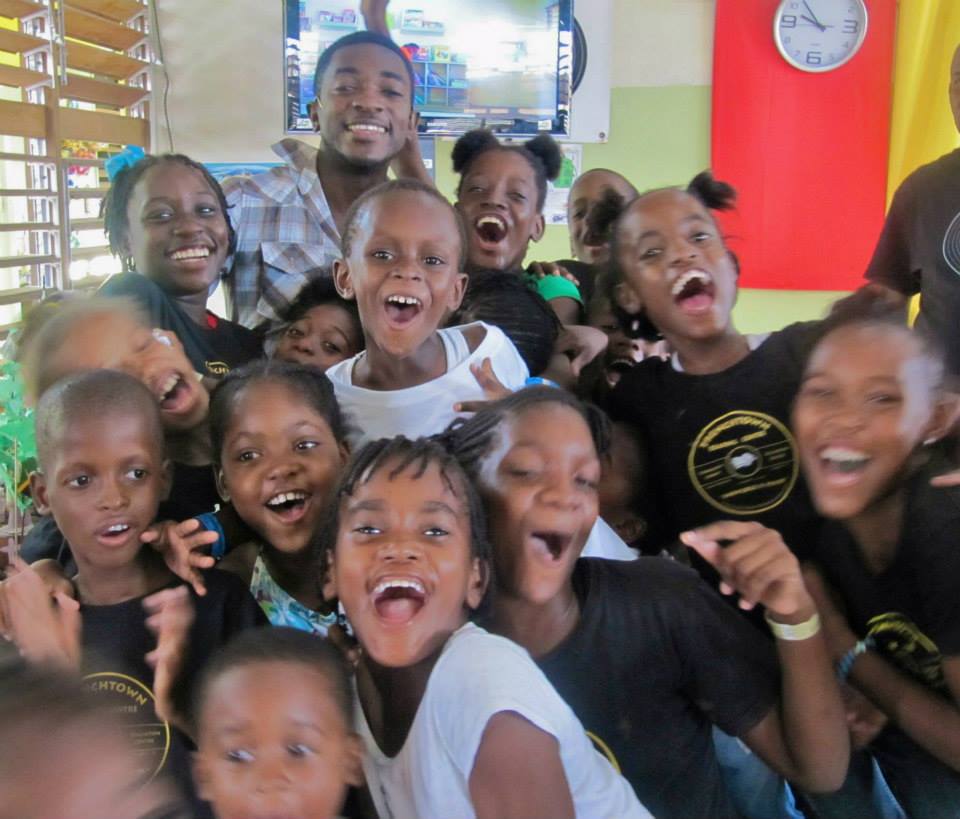
Last weekend, dozens of children gathered at the Trench Town Reading Centre to celebrate its 20th Anniversary. Founded by Canadian Roslyn Ellison, the TTRC has since seen hundreds of children pass through its brightly painted doors, through which they develop and hone their love of reading and learning. Able to accommodate up to 100 children, the TTRC also hosts an annual spelling bee and provides a number of programs for the area.

Please check out their web site, as it tells their story better than I can, from its inception to its battle for space and funding to its many successes. (Trench Town, of course, was Bob Marley’s home for awhile and area residents still face many challenges in terms of poverty and violence, but the TTRC has undoubtedly made a difference in the community). From their web site, here is a little more about what they believe and what they do:

In Trench Town, November 1993, a group of us sat in Bob Marley’s old yard reasoning, trying to find a path forward out of the cycle of violence, poverty and exclusion.

How to strenghten a person, a family, a community’s ability to
choose, plan and succeed in finding a better way?
How to stop the violence?

We chose to focus on knowledge – it was time to improve literacy, learning, information and opportunity.
It was crystal clear that the people of Trench Town would have to do this themselves.
Out of the community’s strong roots and in response to this dialog came the Trenchtown Reading Centre.

Exchange violence for the power of reasoning..
To think. To reason. To learn. To grow.

To be able to make sense of oneself and one’s surroundings – the first step to being able to envision &
create a different reality. Through ideas & the community working together other choices could be made.

The discussion then took a practical turn. Where would the books come from? Where would they be put? What about the contents of the books? As the questions continued, we came up with the concept for a community based and controlled effort to promote literacy, learning and the exchange of ideas.

And here are the programs they offer: (The TTRC currently receives part of its funding from Scotia Wealth Management Division – Scotia Private Client Group, Scotia Investments Jamaica Limited, and Scotia Jamaica Life Insurance Company.)

Library: Book Exchange / Storytelling / Langauge Arts / Read Aloud / Study support …
Literacy / Guided Reading
Spoken word & Drama /Creative Arts /
Community Spelling Bees / Youth performances
Visting Authors, Artists, Performers
Summer School
Seminars; Jobs, Health, Education, Parenting

Unfortunately, I was not able to attend the celebration, but please check out the pictures here and their web site here. This is another good news story of a determined group of individuals persevering in the hopes of making a difference.

Nuh Guh Deh! End sex with our girl child #Jamaica


The concept of the “dirty old man” preying on underage girls for sex is a phenomenon that has so faded and become so normalized that a Jamaican civil society organization has launched a campaign against this horrible practice. This was the message from Eve for Life’s Joy Crawford at an event yesterday

“Nuh Guh Deh” (patois roughly translated to ‘leave it alone’) was launched yesterday by Eve for Life, a Jamaican NGO that aims to create a safe space for girl children and women affected by HIV/AIDS.

(Statistics show that women account for 42 per cent of cases in Jamaica. In the age group 15 to 24 years old, infected women more than double the number of men.)

The technical term is ‘transactional sex’ or ‘cross-generational sex’ and occurs in situations in which older men such as a neighbour, taxi driver or bus driver solicit sex from underage girls in exchange for money or protection. Needless to say, this is a harmful practice for these girls, who are often vulnerable financially, emotionally and physically. In fact, the phenomenon is contributing to increasing HIV rates among girls aged 10-19.

“This campaign is intended to change hearts and attitudes among men and women,” said moderator, blogger and Eve for Life board member Emma Lewis. “We must nourish, nurture and protect our young people,” she said.

According to Eve for Life’s statistics from the Ministry of Health, transactional sex is increasing such that 43 per cent of people aged 15-24 reported being involved in the activity in 2012, up from 39 per cent in 2008. More disturbingly, 20 per cent of girls report that their first sexual encounter was forced, 18 per cent of pregnancies now occur among girls aged up to 19 and HIV infection is now three times higher among girls aged 10-19 than boys the same age.

Less tangibly, the effects of this type of sexual encounter include health risks such as HIV, pregnancy, halting of education and opportunities, all of which condemn girls to a life of poverty and dependency.

Jamaica’s Office of the Children’s Registry (which receives reports of child abuse), recorded 2,300 instances so far in 2012, said OCR’s Greig Smith. “Big man, big woman, leave pickney dem alone. Nuh guh deh!” he added.

Mrs. Marion Scott of the National Family Planning Board of Jamaica called unequivocally on people to “protect the girl child from the cradle robber so that we must give her fair chance at personal development.” Mrs. Scott also noted some disturbing trends, including an increase in multiple partnerships, and a decrease in condom use because of the inherent power struggle, which occurs because the older man automatically has the power as he has the money. As a result, the young pregnant girl is left with the burden and no education and no employment opportunities so she is forced into this unhealthy relationship.

The crowd also heard from a young woman named Nickeisha, who before she turned 17, engaged in a relationship with an older man. Scarred emotionally, she became pregnant but with the help of Eve For Life, managed to escape the trappings of the situation such that she is now an advocate against it. “As someone who has experienced abuse I feel it is my responsibility to say NUH GUH DEH!” Nickeisha said.

Unicef Jamaica’s Deirdre Kiernan (which has provided support to Eve For Life) also spoke at the event, expanding on the reality that underage girls (in Jamaica, the age of consent is 16) are not equipped for sexual activity with older men.

“It is NEVER ok for young girls to have sex with older men,” said Kiernan. “Most girls who have sex with older men not ready and not able to negotiate condom use,” she added.

After hearing some heart-wrenching readings from a 16-year-old’s writings about being sexually abused, the Kriativ Aktivis Randy McLaren and NoMaddz’ Sheldon Shepherd performed. Both did creative rendition of the poetry of Eve For Life’s Joy Crawford.

The launch of the campaign also precedes a series of “community chats” around the island, which will aim to open the dialogue on this phenomenon.

I will leave you with an excerpt of Miss Crawford’s poem, Nuh Guh Deh:

“Now a days Big man pon baby, big man pon toddler, big man pon young girl
A still cradle snatcher, cradle robber, cradle snatcher, cradle robber
We must taunt dem, mek wi haunt dem,
Tell dem nuh guh deh, nuh guh deh, nuh guh deh, nuh guh deh.”

CARICOM and Canada struggling to reach trade deal


In terms of negotiating trade deals, the past few months has seen the focus on the EU trade deal with Canada, known as CETA. There is also a little known negotiating process going on between Canada and the Caribbean region (CARICOM, which is comprised of 15 countries). This is a good article on the pending deal, although it seems both sides have little incentive to reach an agreement.

Have a great day!

Three Little Birds goes classical


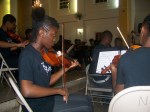
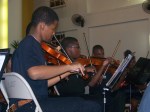
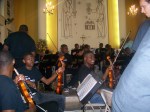
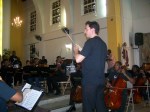
On Saturday night, the National Youth Orchestra of Jamaica gave a spectacular concert to a packed audience at the St. Peter and Paul Church in Kingston. The occasion was a fundraiser for this wonderful group, which trains about 50 youth from inner-city communities to play an instrument. The concert was extra-special as the NYOJ has a guest composer from Spain called Hugo Carrio.

The youth did not have much time to practice, but by all accounts (I did not attend, thank you to fellow volunteers Rhonda and Suzanna for taking pictures), delivered a great performance of a variety of songs, both classical and contemporary. Even some Rihanna and Bob Marley tunes were thrown in. The NYOJ targets youth who would not otherwise have such an opportunity, with most hailing from local high schools like Kingston College, Alpha and Denham Town.

The event was called a Celebracion, A Cultural Infusion, and was also hosted by the Spanish Embassy. Here is an excerpt from a Gleaner story, quoting one of the American instructors:

Avery Waite is one of the instructors. In spite of being on the island for only two months, the lanky American hit the musical spot with his selections and arrangements of Bob Marley’s, Three Little Birds, Redemption Song, and Jamaican folk songs Wata Come a Me Eye and Hold ‘Em Joe. So why did he choose these songs?

“Well, I figured that the kids love playing their own music, music that is familiar, music that they grew up with, that their parents sing to them, so these old Jamaican folk songs with their mento, they just connected on a whole,” Waite explained.

And here is a description of some of Carrio’s quick work with the youth:

With the full orchestra, wood, wind and strings at his finger tips, the youthful-looking maestro had the audience captivated as he guided his musicians through Handel’s Minuet in D arranged by Jamaican Daren Young, Waite’s two folk arrangements and D. Bellwood’s Three Latin Dance.

But it was with Carlos Medrano’s Merengue en Primero that his skill as a conductor was on full display.

The first sign of his creativity came when he had the young student musicians all swaying in unison, then in four groups, he had them doing a dolphin-like dance, or better yet, before moving into a Mexican wave, all the while playing the uptempo Spanish song.

And as if that was not enough, he instructed them to dance in circles, still playing their instruments, much to the delight of the audience who gave a standing ovation and requested a repeat performance of the piece.

He obliged but asked them to join him in giving the count.

Carrio, delighted by both the response from his stewards and the audience, later explained to The Gleaner that he enjoyed the opportunity to teach the children to dance with their instruments, in essence to enjoy the music while playing.

Congratulations to all involved, including fellow Cuso volunteer Karen Prentice.

Trip to Bath


The other day we ventured off to the parish of St. Thomas to visit the legendary Bath mineral springs. The two-hour drive east from Kingston is treacherous in terms of potholed roads, although it is a beautiful drive along the coast. The ocean seems to change colours to a lighter turquoise, the air seems sweeter and cleaner and the atmosphere more peaceful.

Apparently these mineral springs, tucked away between a tiny valley, were discovered by a runaway slave in the 1690s. The hotel reflects the colonial influence. To me, it looked like a Caribbean version of the hotel in the Shining (the horror movie with Jack Nicholson). We toured the hotel briefly, visiting the small rooms where you can soak in a tub that channels in water directly from the hot springs. We were then ushered up a hill and Tom and BigFoot immediately proceeded to give us the full treatment. The masseurs are not formally trained nor recognized as massage therapists, rather they seem to have developed a system that satisfies customers, many of whom are repeat locals. The treatment these young men have created seems to have been centred more on intuition and epitomizes the Jamaican entrepreneurial spirit.

It consisted of wrapping us in our towels, (which were dunked in the hot water and it really was hot, like a bath you have just run and have to ease yourself into), slapping our backs and bellies, massaging us, blessing us with the hot water, giving us a mask with the mud taken directly from the river and then having us lie in the cool water of the river.

It was an extraordinary experience, I might even venture to say it was healing somehow. It was definitely magical, sitting under the bamboo trees and feeling the contrasts between the hot and cold water of the mineral springs. After about half-an-hour, we were released by Tom and Bigfoot, our bodies somehow more limber and less tense. We then got some lunch and drove back to Kingston as the sun set.

Juice Processing workshop in Mountain View


The sweet scent of mango pervaded a room usually reserved for homework and meetings earlier this week on Jacques Road in the community of Mountain View. The reason for this pleasant diversion was that roughly two dozen youths from the inner-city community were taking part in a Juice Processing Workshop sponsored by the Scientific Research Council. The workshop is intended to motivate these young people (most of whom are unemployed) provide them with a skill and ultimately, the means to achieve income-generation. (Jamaica’s youth unemployment rate is about 40 per cent and for Mountain View, it is probably higher than that).

“This is a high crime area,” said Scientific Research Council administrative assistant Nicole Colley-Lewis, “and men are prone to become part of a gang. If they are trained, it is less likely that they will go to a gangs and instead they may start a business,” she said.

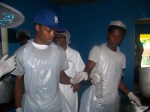
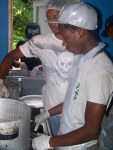
The workshop was arranged by the SRC through the Social Development Commission and offered several hours of training in juice processing. This included hands on activities like sterilizing the bottles, mixing the cordial (sweet syrup) with water according to strict chemical formulations and boiling the mixture to achieve the perfect combination. Indeed, many of the youth were taking extensive notes of complicated chemical equations.

“This is definitely something I would be interested in,” said Odayne Treasure, who already has a certificate for bar tending. Garnett Rhoden, 33, agreed. “It requires a lot of help and dedication to start a business, but yes, if given the chance, I would” he said of the opportunity to use this training to start such a business. Rhoden is currently doing “any likkle thing to make money,” including working as a barber and a mechanic. He is also a talented landscaper, but because he does not have his own equipment, he cannot compete with others who do. What Rhoden really wants to do, however, is continue training to be certified as a barber. He can already do intricate designs when he cuts people’s hair, a practice which can earn him $1,000 (about $10US) every time.

This is a common challenge for inner-city youth: they do not lack the passion, nor is there a shortage of ideas, rather, they are not exposed to the opportunities such as training in how to start a business that their peers can access. That is why for this juice processing workshop, the next stage is to receive such training. Beyond learning the formulations to make the juice, they will receive training in how to start a business. This will include sessions with the Jamaica Business Development Council on how to write a business plan, among other instruction.

“We are hoping that these youth gain some knowledge to start thinking about generating their own business,” said Social Development Commission Community Development Officer Princess Bryan-Colley. Ultimately, the goal is to create a small business making juice that could be sold back to community members or schools and become an income-generating activity.

“We hope they gain more knowledge and become more self-reliant and gain skills that they can use for income generating activities. We also want to teach them some discipline,” said Jacques Road Parenting Association’s Francena Pryce.

Transforming the Caribbean region through volunteerism


Guest post today from fellow Cuso colleagues Rhonda Belous and Onyka Barrett. They compiled this report on a recent volunteer symposium that aims to better link the private sector, the voluntary sector and government to enhance volunteerism in Jamaica. Enjoy!

Transforming the Caribbean region through volunteerism

Kingston, Jamaica, October 22nd-25th, 2013 – Cuso International in Jamaica joined forces with the Council for Voluntary Social Services (CVSS) and the Jamaica National Building Society Foundation – the Corporate Social Responsibility arm of the Jamaica National Building Society (JNBS) – to host the Caribbean Regional Volunteerism Symposium 2013.

This collaboration allowed for the gathering of a variety of CBOs, NGOs, Government Agencies & International organisations and generated a treasured collection of shared knowledge, expertise, and country-specific initiatives that will contribute to raising the profile on the value of volunteerism within the Caribbean region.

This was all part of a Caribbean Regional Study Tour on National Volunteerism organized by Cuso International in Jamaica. The Study Tour featured visits to Partner agencies projects, a Workshop focused on tools for creating an enabling environment for volunteerism and a Regional Symposium focused on the value, impact & potential for volunteerism to foster development.

Regional participants included representatives of UNDP, Barbados & the OECS, Ministry of Culture, Youth & Sport, Guyana, Volunteer Centre of Trinidad & Tobago and Ministry of Culture, Youth & Sport, Dominica.

The 2013 Caribbean Regional Volunteerism Symposium, “Transformation through Volunteerism” was held on October 25th, opened with a prayer from Mrs. Georgia Lewis Scott, Executive Director of Youth Opportunities Unlimited (YOU), as she made a plea for Jamaica to “be the thriving country it aspires to be.”

“This is your day,” said Mr. Tarik Perkins, Country Representative, Cuso International as he welcomed all guests and in particular all national and international volunteers.

Onyka Barrett, Cuso International’s Caribbean Regional Advisor/ Programme Manager for National Volunteering shared her personal vision: “how to package, brand and move the agenda of national volunteerism forward,” and continued by saying, “this is one step in a process; there is a need for continuous improvement and engagement.”

“We must influence policy makers, and create effective national volunteer programs; we cannot do it on our own,” said Winsome Wilkins, CEO of Council of Voluntary Social Services (CVSS).

Mr. Earl Jarrett, General Manager, Jamaica National Building Society, delivered the keynote address. He emphasized the need to “identify greater partnerships between the state, our voluntary community and the private sector” as we seek to create a difference in our communities.” He said that volunteerism can encompass a broad range of involvement and support, including effective vehicles for poverty reduction, and we must also encourage and value volunteers who monitor and drive policy change, such as tax reform and keeping our pulse on IMF initiatives. “Without volunteers conducting all of these types of activities, the economy would collapse,” he continued.

Ms. Saffrey Brown, General Manager of the JN Foundation, used the opportunity to showcase the organisation’s volunteer core – Act!on Jamaica volunteers – as well as highlight other CSR initiatives that champion volunteerism.

The symposium was rounded out with interactive panel discussions, moderated by Mrs. Georgia Lewis Scott on topics such as “Creating an Enabling Environment for Volunteerism – Successes and Challenges, Opportunities & Best Practices” and “Making Volunteerism Matter to the Individual.”

Universal Children’s Day


This is how it should be: children enjoying themselves, uninhibited by fear of violence and abuse, free to experience the simple pleasures that are a staple of a safe and happy childhood. Unfortunately, throughout much of the world, this is not the case.

So today the United Nations celebrates Universal Children’s Day, which is also the 20th anniversary of the Convention of the Rights of the Child.

This year’s theme focuses on reducing incidences of violence against children. In an ideal world, which the United Nations strives for, there would be no need to mark such anniversaries or call for people to stop abusing vulnerable and innocent children. However, violence and abuse are still prevalent throughout the world.

Check out this report from the United Nations.

According to this report, violence affects children in the following ways:

Violence can have many effects on children, which can still be felt many years later… Effects may include:
• physical health problems, such as changes in the development of the brain, injuries, bruises and fractures.
• difficulties in dealing with other people and learning problems.
• finding it hard to express feelings in a way that other people can understand.
• emotional health problems including anxiety, depression, aggression or even wanting
to kill him or herself.
• being more likely to do dangerous things like using drugs or having sex at a very
young age.

Specific to Jamaica, a 2011 United Nations Country Report found that between 2007 and 2009, there were 11,434 “incidents” reported to the Office of the Children’s Registry. This includes all types of abuse, pregnancy, trafficking and substance abuse.

To this end, the United Nations office in Jamaica has made the following recommendations to officials to tackle the problem of abuse and violence:

UNCRC Recommendation #33
The Committee urges the State party to take steps to strengthen considerably its efforts to address and condemn violence in society, including violence against women and children, particularly in the context of the family as well as in schools and other such environments. Further, it recommends that the State party take steps to monitor and address any incidents of violence and sexual or other abuse against children and take measures to ensure the rehabilitation of traumatized and victimized children by:
 Public education campaigns re negative consequences of violence and ill treatment of children and promoting positive non-violent forms of conflict resolution and discipline within the family and the education system
 Legislative measures to prohibit all forms of physical and mental violence including corporal punishment and sexual abuse against children
 Measures to prevent violence in families, schools, and by the police and other State agents, making sure that perpetrators of these violent acts are brought to justice
 Providing care recovery and reintegration of child victims ensuring that the child is not victimised during legal proceedings and that privacy is protected
 Seeking assistance from UNICEF and WHO

If one judges by the headlines in the media, the situation in Jamaica for children remains dire and quite depressing. However, there is no shortage of groups and individuals trying to create a safe place in which children can be happy, joyous and free.

I will leave you with a quote from a Unicef official: “Too often, abuse occurs in the shadows: undetected, unreported, and – even worse – too often accepted,” said UNICEF Executive Director Anthony Lake. “We all have a responsibility to ‘make the invisible, visible’ – from governments enacting and enforcing laws to prohibit violence against children, to private citizens refusing to be silent when they witness or suspect abuse.”

Edna Manley teachers will be required to retire earlier


Jamaica is currently the beneficiary of a four-year, $958 million US Extended Fund Facility loan from the International Monetary Fund. In layman’s terms, Jamaica is receiving conditional international financial assistance aimed at improving the anemic state of the economy. Here is a good article on the subject, and while the fact that Jamaica must continue to submit itself to the conditions of the international system that originally (many argue) caused its demise, the country is meeting the targets set out by said system. (It must undergo 15 reviews and meet conditions to unlock the funding).

Here is analyst Aubyn Hill explaining the exact improvements better than I can:

The Net International Reserve (NIR), which had slipped progressively from about US$2 billion at the end of 2011, stood at US$912.3 million at the end of September and was US$151.1 million above the US$761.2 million target.

Reserves and grants in April to September 2013 were J$27.2 billion higher, recurrent expenditure was J$4.8 billion lower, capital expenditure was J$8 billion higher and loan receipts (borrowings) were J$58.5 billion lower compared to the same period in 2012.

These and other statistics served to reduce our planned Budget expenditure by J$10.9 billion and recorded a J$6.6-billion fiscal deficit, which was significantly better than the J$10.4-billion deficit figure that was in the Budget for the quarter under review.

And for further reference, if you are so inclined, check out these documents and links with more information on the IMF agreement.

Request for an Extended Fund Facility with the International Monetary Fund.

Jamaica’s Memorandum of Economic and Financial Policies

Here is a good explanation of Jamaica’s current state of financial affairs, from the government:

Jamaica faces severe economic challenges. Since the mid-1990s, real GDP growth averaged less than 1 percent a year, which has contributed to sustained high unemployment rates and large-scale emigration of labor. Anemic growth and recurring bouts of financial market instability have been rooted in increasingly high levels of public debt, which reached 137 percent of GDP at the end of 2011, and is currently approaching 150 percent of GDP. Sustained high debt service obligations and large refinancing needs have resulted in costly risk premiums and helped crowd out private sector investment. The high debt levels have also exposed the country to adverse shifts in market sentiment. With interest payments alone accounting for approximately 37 percent of government revenues, the fiscal accounts are stretched too thin to pursue productivity-enhancing social and infrastructure investment.

This is the high level view. On the ground, however, it is a different story in terms of how the agreement is impacting people’s daily lives. I have been trying to wrap my head around the IMF agreement for some time now, both at the micro and macro level, and this situation I heard about the other day is helping me to do so. My friend Ann McNamee teaches at Edna Manley College of the Visual and Performing Arts and because of the IMF agreement, will be out of a job soon.

Because of a regulation buried deep in the agreement, teachers will now not be able to work past the age of 60, whereas before they were granted extensions until age 65. Because Edna Manley falls under the jurisdiction of the Ministry of Education, its employees are public sector workers, with wages governed by federal legislation. The closest thing to an explanation I can find is here, from the Memorandum of Economic and Financial Policies:

Spending on education will also be made more efficient and effective. There will be a balancing of student-teacher ratio within and between schools. This will be achieved through, among other things:
 Structured attrition e.g. a freeze on the hiring of new teachers in schools that are overstaffed, to allow the number of existing teachers to decline by attrition.
 Mandatory retirement at the normal retirement age (schools with teachers beyond retirement age will be notified to regularize by September 2013).
 Standardization of the student/teacher ratios at the secondary level (to begin 2013).
 Establishing a clear accountability mechanism enabling the Central Government to set policies that grant schools more autonomy particularly with respect to greater flexibility in the deployment and redeployment of teachers.
 The process of voluntary reallocation of staff will continue over the medium term pending the enabling legislation for mandatory redeployment (enactment by FY 2015/16).
Other measures include reforming the current study leave policies to take account of the new hiring policy; restructuring the current scholarship programmes into separate need-based and merit-based components (review and design of the scholarship mechanism in the 2013/14 academic year with full implementation in 2014); instituting greater cost recovery at the tertiary level and improving the funding structure of the student loan scheme to facilitate increased access to tertiary level training.

But here is the explanation from my friend:

The issue with the IMF is that the government is to be careful how they spend our tax dollars. :-). The real problem is the Ministry of Education that thinks Edna Manley is a teacher’s college and the staff can be easily replaced! The rest of the world understands that expertise and experience is important in teaching the arts. The retirement age is 60 but in the past they’ve allowed faculty to stay until 65 when the Director of the different schools has requested it. I got my letter last week so I’m to retire in August.

Teachers and staff at Edna Manley are concerned for several reason, mainly that they will be losing experienced professionals who are not easily replaced. This is a shame. Despite budgetary challenges, Edna Manley has consistently educated and produced thousands of talented artists over the years. It would be a shame to lose the core group of professionals who are instrumental in this process.