


A Rae Town fisherman, fixing engines.
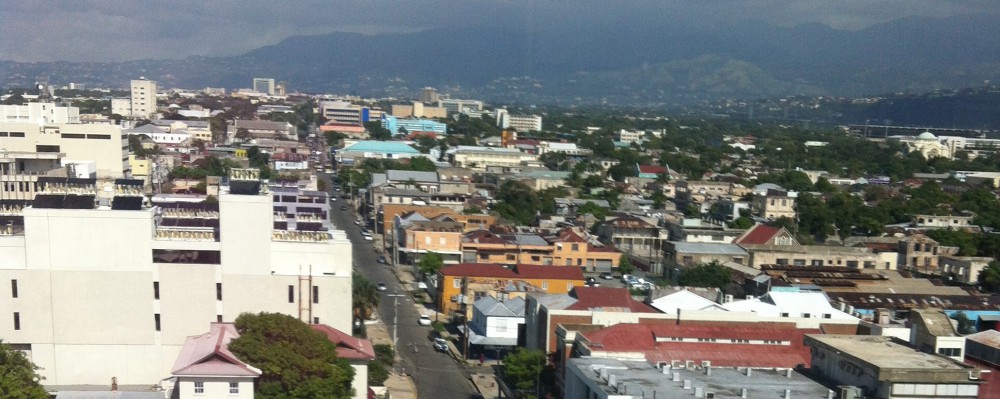
A Rae Town fisherman, fixing engines.
Check out the amazing work my friend Karen and her organization, as well as the Minister of State for National Security’s office, is doing with young women at the South Camp Rehabilitation Facility.


Just a selection of some of the multimedia projects. A talented group, to be sure. Congratulations and good luck!

The University of Technology’s Final Year Student Exhibition is being held this week to celebrate fourth year students’ achievements. In honor of this, esterday marked the arrival of CNN’s now-retired vice-president and senior editorial director of news, Richard T. Griffiths.
Prior to his remarks, we were first treated to the performances of a couple of original poems by students, as well as a video showcasing some of the students’ work. Then Mr. Griffiths spoke. I am so grateful that I attended, as his speech somehow crystallized some ideas and answered some questions I have been pondering for a year now since I began teaching journalism at Utech.
Mr. Griffiths discussed the state of the news media in general from both the perspective of a journalist as well as a business executive mindful of the bottom line.
He leaned heavily on some metaphorical thinking, evoking the beautiful images of navigating one’s way through volatile and violent rapids. He showed us pictures from his family vacation, their successful maneuvering through one set of particularly dangerous rapids. And he applied this to the current media landscape, but also made sure to point out that history is repeating itself, specifically the explosion of social media and its effect on journalism can be compared with the yellow journalism of the turn of the 19th Century. This was when newspapers inflated news and headlines simply to sell papers.
He referred to William Randolph Hearst, who owned the New York Journal, and was competing with the Pulitzer family’s New York World. At that time, he found that daily stories of war sold papers, so he latched on to the Cuban revolt against Spain. He even sent a reporter down there, who discovered no such war. No worries, said Hearst.
“Please remain. You furnish the pictures and I’ll furnish the war.”
This famous quote (although there is some dispute as to whether or not this actually happened) illustrates the extent to which he was willing to go to sell news. In fact, several weeks later a U.S. ship exploded, killing 274 people, which was actual news that the was further able to latch on to.
The point of this story was to show the power that social media has to break news. The missing ingredient, however, is the fact-checking process, the provision of background and investigative journalism. These are skills specific to journalists, Griffiths said.
He also discussed the severe lack of trust, which is a global phenomenon, he said, referring to the Edelman Trust Barometer for 2017. “To be effective as media, you have to be trusted,” he said.
The lack of trust, he said, is “scary stuff for journalists.” The general atmosphere surrounding the media, especially amongst some citizens of certain Eastern European nations (who he said attempted to alter the election results with fake news), is a “clear ploy to undermine trust in the institutions that challenge” those in authority.
In the past few years, he added, the media has failed in several ways. These include a failure to adapt quickly enough to new technology, an arrogance about correcting mistakes, not being sufficiently clear about the processes and practices of journalism and the lack of clear delineation between fact and opinion.
Griffiths’ speech concluded with a question and answer period, then we were off to view the students’ projects.
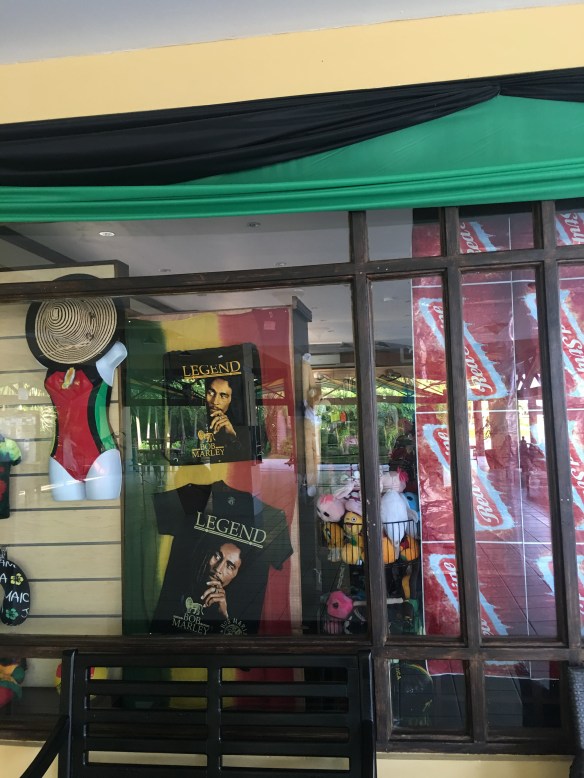
Bob Marley’s image is all over this resort, for sale and for decoration. I heard the Legend album played over and over and the house musicians also played songs for the evening entertainment. The tourists seem to enjoy it. It is always strange to see the discrepancy, Bob Marley as commodity, versus Bob Marley as legend and hero to an entire nation.
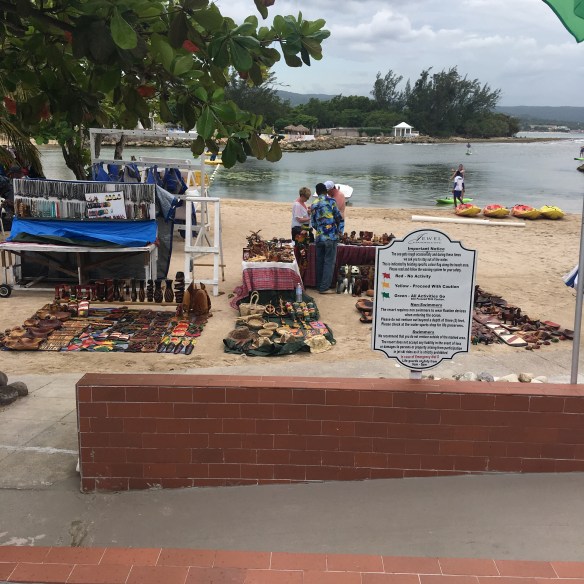
The vendors here seem particularly skilled at reeling the tourists in. This resort seems to accommodate mostly American and Canadian tourists. I wonder if they know that these products are likely made in China.
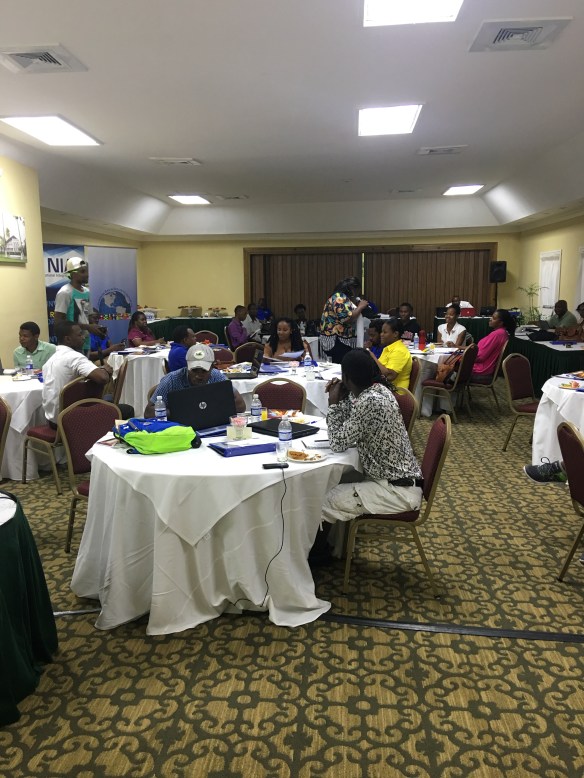
What an eventful weekend. Global Reporters for the Caribbean had three days of community journalism training, in partnership with the National Integrity Action and USAID’s COMET II program.
We had 17 sessions, 11 presenters and over 30 trainees from across the island. The presenters included Nationwide News’ Dennis Brooks and Kalilah Reynolds, TVJ’s Yvonne Chin, communications consultation Indi Mclymont, climate change expert Holly-Rose McFarlane, police officers from MOCA, myself and Zahra Burton. Even for an experienced journalist, there was a lot to learn.
And in the middle of day one of the training, Nationwide News contacted me to request that I come on Cliff Hughes talk show with host Mark Wignall to discuss my article on lotto scamming. I have not done much radio, let alone a 15 minute interview. It is always strange being on the other side, but I think it went alright. I wanted to have a chance to refer to pieced by local journalists on the subject that were much more comprehensive than mine, like CVM’s, and of course 18 Degrees North, but did not have a chance. Anyway, thank you Mr. Wignall for the opportunity.
Now, it is time for 10 groups to produce a publishable journalistic piece derived from story ideas we have worked out together. The focus is on accountability and of course, integrity and impact.


Scenes from Earl “Chinna” Smith’s house, for a story I am working on.
 Jamaican Journal