"And all I offer here is the distilled poetry of my existence..." Claude McKay,
Poet Laureate of Jamaica, 1890-1848
I have been a reporter since 1998, covering mainly business and politics. I have also capitalized on the many skills journalism requires to become an all-around communications specialist. In addition to being a professional curious person and communicator, I have a bad case of the travel bug and can't seem to stay put. Finally, I have put my skills to work as a volunteer in the community wherever I have lived. Now, follow me as I combine these compartments of my life in Kingston, Jamaica, where I am a writer, reporter, journalist and lecturer.
It is Labour Day in North America today, of course, but in Jamaica, thousands of children are back at school. And they will be the subject this year of a new “behaviour modification” program aimed at fostering better social skills.
Educators recently underwent this training courtesy of an American expert in “SWPBIS“- School-wide Positive Behaviour Support, in non-jargon terms.
Developed by Connecticut-based Dr. George Sugai’s Center for Behavioural Education and Research, the training aims to impart better ways of interacting through positive interventions. Here is Dr. Sugai:
“The outcomes have been reduction in serious problem behaviour, reduction in reactive management, which is sort of punishment; improvement in academic outcomes, improvement in school safety and climate; and improvement in parents’ perceptions of the quality of the school. So the outcomes have been very good.”
It seems the interventions are based on instilling respect for oneself and others. Lovely thoughts, of course, but I always wonder about the cultural translation. American culture is not the same as Jamaican culture, so how was it tailored and received by Jamaican educators?
Yesterday I had to go downtown on the coaster bus, which would drop me off right in front of my destination. However, when we reached the area, the driver had to divert from the regular route as there was a fire. So I was left wandering around for a few minutes, not knowing where I was. Traffic was also a mess. A minor inconvenience.
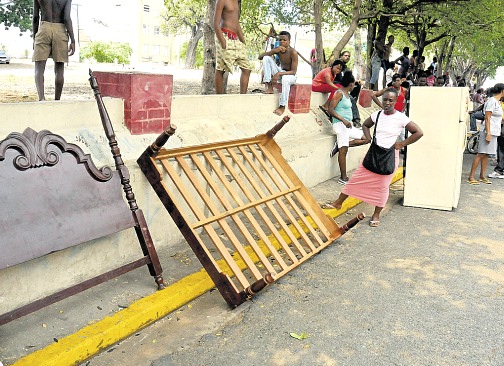
Forty people are now homeless, including 15 children, as a result of a possible case of arson. Here is one of the people affected, called Charmaine Burch:
“Everything fi mi pickney dem back-to-school bun up; nutten me nuh save. How me a go face this now? Me no know how it going go. My fridge, me stove, me bed, me dresser, me TV, me DVD, everything gone. No clothes not on me baby dem back,” the woman said as tears flowed down her cheeks.
Apparently, people are alleging that the young men who live in the gully are involved and police are investigating. This is an impoverished area of Kingston and it appears these 40 people were squatting in a former government building. Thankfully, no one perished.
The role and responsibility of a journalist is something I think about a lot, probably too much. Especially when it comes to being a person with white skin and the accompanying privilege. And especially as social media is changing the role as we speak, to an almost unrecognizable profession that now includes “citizen journalists.”
New York Times Nicholas Kristof exemplifies, for me, some aspects of the debate about the role and responsibility of a journalist in society. Some see him as a hero, delivering news of the underprivileged and marginalized from all corners of the world, while some see him as only doing harm. For me, as usual, the truth lies somewhere in the middle, with the underlying reality being that Kristof is ultimately a flawed human being who is probably consumed by both a drive to do what he thinks is the right thing and his ego.
In any case, I urge you to read his column today in the Times. It is a take on what is happening in Ferguson, on the riots over Michael Brown’s death by the hands of a police officer. For me, this is typical Kristof, a high level view that doesn’t incorporate the nuances and grey shading that are so important to consider in cases like this. However, he does make some strong points and shed light on some important research.
Are we all a little bit racist? he asks. The answer seems obvious to me, hence why I spend so much time thinking about the role and responsibility of a journalist in society. But I guess it is not obvious to everyone. I think that we all harbour biases, judgements and yes, even racism in our brains. The challenge is to try to be aware of them, think through them and see how we allow them to operate in our daily lives and interactions.
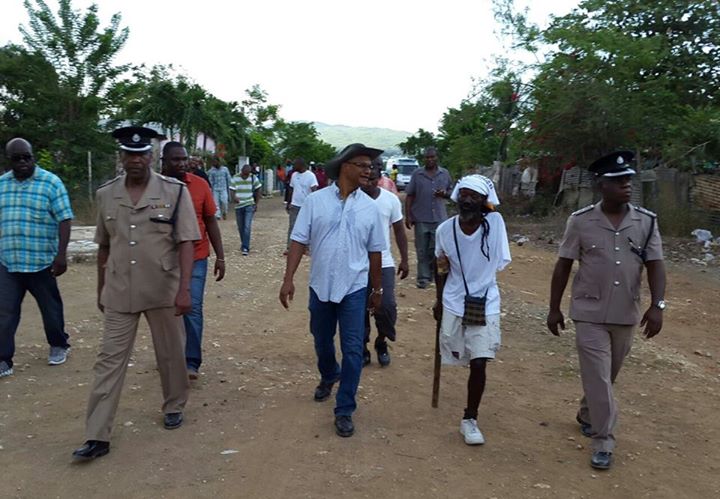
I took this picture from National Security Minister Peter Bunting’s Facebook page. Here is what he wrote to accompany it:
This gentleman walked with us for one hour on the most uneven of surfaces. One arm and one leg, yet he pushes a hand cart chipping and selling coconuts, and now seeing that his community is in crisis he has come out in solidarity. What an inspiration! PB #CanaanHeightsPeaceMarch Let’s #UniteForChange #StrongerTogether
When people say the economy in Jamaica is improving, at least by the standards set by the IMF, I tend to ponder this in the context of the headlines. (I know you cannot conflate on-paper, economic measurements with conditions on the ground, but I always think the contrasting contexts are interesting.)
Specifically, I like to measure in terms of being a young person, whose parents pay taxes, trying to get an education. It is not an easy time to be a student in Jamaica.
Drought may force students to bring their own water to flush toilets and to perform basic hygienic activities. In other words, students can’t even go to school and expect to be healthy and safe at some locations.
Textbook prices are up, forcing parents to pay more money for basic necessities of learning. These textbooks are mandatory for students, at least in terms of keeping up with peers and being able to perform in tests.
Bus fares are up, hitting the most vulnerable populations – the elderly, minimum wage workers and students.
So it is not an easy time for people endeavouring to improve their chances of success and a happy, healthy life with the most basic of tools that a nation should provide. After all, the United Nations Convention on the Rights of the Child states that children have a right to education. Are their rights being violated here in Jamaica if they can’t afford to get to school, can’t afford text books and cannot expect sanitary conditions?
Originally posted on the stories we tell…: It was a dream: a pipe dream some may have thought… a far off mirage that wasn’t in my ‘work plan’ I thought, but a dream none the less: to get twenty-five at-risk…
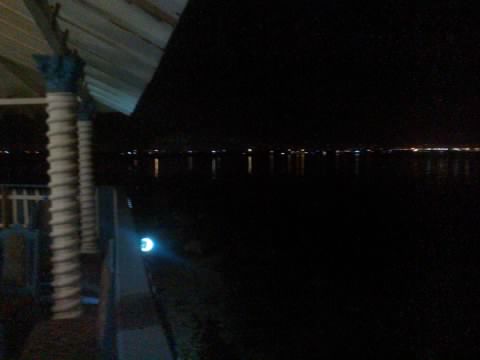
A tropical wave has hit the island this weekend. There were terrific thunderstorms yesterday and a downpour of rain. During a break, we went out to Portmore for fresh fish, and there was a beautiful lightning show. This is the view from Portmore, looking out onto the twinkling lights of the harbour and the hills. Hope you are enjoying your Sunday.
I feel as though I won a gold medal today, a reward for the specific task of surviving seven hours of Jamaican bureaucracy. This spanned three offices, about a dozen forms, many lines, many helpful clerks and much hustling around the city. But I accomplished what was necessary!
In relation to yesterday’s blog post, please check out this thoughtful article on the relation between the riots in Ferguson and the Ice Bucket Challenge. It has got me thinking, at least.
Hope you had a good Friday.
The Ice Bucket Challenge has hit Jamaica. Youth and Culture Minister Lisa Hanna undertook it yesterday and challenged some colleagues to follow her. If you are not aware, the way it works is that someone dumps a bucket of ice water over their head and then names a couple of people who must follow suit within 24 hours. If they do not, they must donate money to a charitable cause, preferably ALS. (Just curious- why would you dump a bucket of water over your head when you are sitting at your computer, a question fellow blogger Emma asked yesterday.)
The challenge, which has overtaken social media and the world and the celebrity sphere, is a brilliant marketing concept. There are critics, of course, who call it slacktivism, which seems particularly harsh to me. (Check out one of the most negative pieces here, from Vice Magazine.)
I have given my own opinion on the concept of slacktivism, arguing true activism requires some substance behind a person’s motives, and that they must not solely fall into following a trend. (Check out my piece here). However, in this case, I can’t see any downside.
The Ice Bucket Challenge has raised over $15 million US and it has most certainly educated more people about this horrible disease. How is any of that detrimental? I suppose you could argue that people are in fact taking the challenge NOT to raise money when they actually douse themselves with water (because by doing so, they forgo donating the “required” donation), however, it seems to be effective, measured both financially and in terms of the increased level awareness of the disease.
For Jamaica, however, I would add some caveats in terms of whether or not this craze should catch on here. The country is in a drought, for one. (The ALS site suggests you can “repurpose” the water if you are in an area with water challenges, but how would one do this if it is flung everywhere?) Even when it is not in a drought situation, water is a scarce resource in some communities. (I cringe when I think of what people in the rural communities, who must walk with large buckets to get water, would think if they saw this). It also takes precious power to create ice and generating power is expensive in this nation. So let’s tweak the challenge for Jamaica. Instead of dumping a bucket of ice over one’s head, why don’t we challenge one another to report any water leaks we see on the road. If they cannot do so, they can go ahead and donate $100 to the cause.