Unknown's avatar

About Kate Chappell

"And all I offer here is the distilled poetry of my existence..." Claude McKay, Poet Laureate of Jamaica, 1890-1848 I have been a reporter since 1998, covering mainly business and politics. I have also capitalized on the many skills journalism requires to become an all-around communications specialist. In addition to being a professional curious person and communicator, I have a bad case of the travel bug and can't seem to stay put. Finally, I have put my skills to work as a volunteer in the community wherever I have lived. Now, follow me as I combine these compartments of my life in Kingston, Jamaica, where I am a writer, reporter, journalist and lecturer.

“Like a disease”


This morning after I finished my run up at the University, I hopped into a route taxi to take me home. The driver and a passenger were in the front and it was me alone in the back. As we approached a small traffic jam, the driver stopped the crawl of cars to let a woman pass in front of him.

“Let har pass,” he yelled out the window at the driver trying to proceed on the other side of the road. The young and shapely woman passed in front of our car and said “Tanks,” and the driver said, “Yes baby.”

As the driver and passenger both kept very keen eyes on her progress in front of us, he said, “Loving dem woman dem is like a disease.” The young passenger laughed and agreed.

“You treat women dem good and they still treat you like sh**.” They both laughed for awhile.

Its pretty clear even in patois, but this taxi driver seems to feel that loving woman and treating them well is an affliction he can’t escape.

Just an interesting moment from my day, all before 9am. Have a good one.

“…we have a responsibility to prevent human suffering”


Whether we are in Iraq or Rwanda, we have a responsibility to prevent human suffering; placing children at the top of that agenda should be key to this rationale.

This is a quote from an op-ed in today’s Washington Post by Romeo Dallaire, the Canadian soldier who witnessed the Rwandan genocide. He is warning of another possible genocide in Iraq. His words should carry weight, let’s hope it is sufficient to prompt some kind of action. Check out his article here.

Ozan


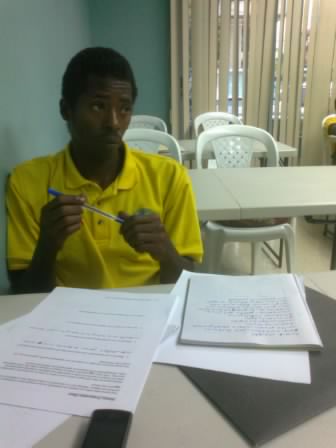
Yesterday we did a training session for some intellectually disabled youth about the importance of mentoring. This is Ozan. He diligently took notes the entire session, word for word. His writing was precise and neat and he seemed to soak up ever word we said.

After the session, a young man dubbed the “Professor” thanked us with a handshake and a hug. It was a wonderful few hours.

Buying Jamaican is sometimes not the best option?


I try to buy local produce as much as possible as it is more cost effective and supportive of the farming industry. With fruits, this is no problem. Bananas, mangoes, naseberries, papaya and sugar cane are in abundance. For vegetables, sometimes this is a little bit more difficult. As a result, I eat a lot of pumpkin, carrot and cauliflower. Those seem to be the cheapest and most readily available.

Lately, however, I noticed that the carrots are getting skinnier and the cauliflower sometimes is not even stocked. I assumed it was a result of the drought. The other day I was in a supermarket and noticed that the local carrots had doubled in price, while these imported carrots, fat and vibrant, were cheaper than those from Jamaica.

I caved in and bought the imported carrots. I am wondering why importers are now bringing in carrots and why they are now cheaper than local ones. I am not an economist so I can only speculate about basic reasons. Supply has decreased while demand stays the same, pushing up prices. And the customer will usually act in his or her own best interests, influencing prices.

I hope this practice does not continue and that the weather is indeed the determining factor in the supermarket owner’s decision to import carrots. We have had some rain so this will help local farmers.

To shine more light on this issue, please check out this post from a new web site called Daily Veritas.

Man threatens to jump if his song not aired on radio


Half-Way Tree came to a halt yesterday after a man climbed a broadcasting tower and threatened to jump if a local radio station did not play his music. He was eventually coaxed down into safety. I’m not sure if the station played his music.

This web site claims his song was played. It also claims the man is suicidal. In any case, this was a tragic event that ended well, at least for now. Let’s hope this man gets help.

What it’s like to live with someone with mental illness


I wrote this several years ago, but it seems relevant today:

What is the most terrifying moment of your life? The moment that adrenaline revs your heart so that it pounds in your ears? The moment your brain is forced to confront how you feel about dying? For me, that moment occurred in the pre-dawn hours of a late spring day, a time when nature buzzes with the frenetic activity of recreating itself for another year.
Her soft voice first drew me gently from sleep. As my eyes opened and I processed the horrific scene in front of me, I was shocked awake.

My beloved younger sister stood in my doorway, her face a mess of tears and marred make-up. “I’m sorry,” she kept repeating. It took several moments for me to process the information in front of me. Her wrists were wrapped in white towels. That could mean only one thing. I rose from bed, driven by fear and a single thought: “Do something fast, or your sister is going to die.” Somehow, I remained calm as together we unpeeled the towels from her arms to assess the damage. The stark stain of blood on the white fabric is perhaps the most offensive thing I have ever seen, evidence of my sister’s pain and her bid to escape it.

She had sliced her wrists with a razor blade. We rewrapped them and I told her to put pressure on the wounds. I stumbled to the phone and called 911. Adrenaline and fear had so altered my faculties that I could barely speak. I managed to tell the operator why we needed help. The rest is a blur as I attempted to keep my sister calm and myself from succumbing to the potentially paralyzing fear I was feeling.

A fire-truck arrived first, no sirens, but its garish lights flashing, glancing off neighbouring homes. Two huge men entered our house, perhaps slightly ill-equipped to coax a terrified, confused teenager to accept help. Eventually, they succeeded and we were loaded into an ambulance. Upon arriving at the hospital, we sat side-by-side on the waiting room’s orange plastic chairs for about six hours. Finally, a doctor repaired her broken skin, then attempted to address her shattered spirit.

That was over a decade ago, and this macabre dance with mental illness has not ended for our family. I have never known life without feeling the ravages of mental illness.
As a child, I intuitively understood my sister’s precarious and ambivalent existence. I sensed the fraying string that tethered her to the earth.

It wasn’t until she was a teenager that she began to act on the torment of an ill brain. She has had numerous suicide attempts over the years, the most recent being more several years ago. The worst time is always autumn, when the light recedes and the rest of the world embarks on a new season of professional and academic endeavors. During this season of grey light and falling snow, every time the phone rings, I am on edge, expecting the news that she has succeeded in her attempt to leave life.

A couple of times, my sister ceased communication with me altogether, both periods lasting several months. The lack of contact and knowledge of how she was coping were excruciating. She later told me that she stopped talking to me in an attempt to dull our tight bond so that it would be less painful for me when she killed herself.
Her suicide attempts have consisted of pounding back dozens of pills, pumping her body with the poison of the medication that is supposed to save someone pain when ingested responsibly.

My beloved sister has not been successful in killing herself. In fact, she is doing better now. But she has been medicated for almost 20 years and may never be able to be free of drugs if she wants to live. And she does. But sometimes she doesn’t. On those very worst days a couple of years ago, my sister and I lived together. I was loathe to leave the house, even leave her side, lest she kill herself. My cell phone stayed within reach at all times. I cooked her favourite foods for her, even though she didn’t enjoy them, covered her with blankets, stroked her hair and chattered on about my day in futile attempts to cheer her up.

But you can’t just cheer someone up who is assaulted so gravely by serious mental illness. What seared my soul in the worst way was how dead her eyes appeared. How void of spirit her body was. How flat her voice sounded. In those moments, when my eyes met her lifeless ones, two emotions coursed through me: terror and rage. “Why can’t you just feel better?” I would scream within. “Why can’t you just take a shower and go for a walk? Is life really that bad?’ Of course, I never said this to her, and I never really meant it.

Instead, I learned to love her. I learned to accept her as she was, as well as my own panic and fear, both of which sparked this brutal judgment. I learned how to love a person whose spirit has been so sapped that they can barely tend to their most basic physical needs. I learned about loyalty and commitment and choice. And I learned gratitude. Every day she made it through another 24 hours, I was grateful. In turn, I learned to appreciate those around me, from those I love dearly to strangers on the street.

During the most horrible time, people offered suggestions and asked questions. Should she be hospitalized? You must get on with your life, be true to yourself, they said. To a certain extent, I did. But I never, ever allowed myself to lose hope in my brilliant, beautiful sister.

There was never any other option. What else could I do? Give up on her? I held on with desperation to the hope that if I continued to love her, to believe in her, to tell her I would never give up on her, an atom or two of this love might fuse its way into her brain and convince her to try to jump back into life. Maybe that new atom would float in and dispel whatever nasty hormonal concoction was fooling so cruelly with the chemistry of her brain.

Needless to say, my sister, who so bravely every day fights to want to live, is not alone. Most of us know someone who battles mental illness, or we do ourselves. But the stigma and shame of having a brain plagued by unbearable, unpleasant thoughts and feelings and skewed chemistry keeps us from seeking help.

This is an unfortunate reality that needs to change. There also needs to be an increased focus on research, although human nature is such that we will likely never be able to fully prevent suicide. In addition to focusing on research, we must raise awareness. Suicide is preventable, but irreversible when it occurs, and this reality should prompt us to discuss it more openly and without shame.

As human beings, most of us possess a natural aversion to discussing such a mystifying, counterintuitive action as ending our own life. We instinctively strive to preserve ourselves at all costs, so when a fellow human being does not act in accordance with this fundamental drive, it causes fear and confusion. But this is precisely why we should address this reality: the pain does not have to be endured alone, and the abolishment of a solitary struggle could prevent some loss. Our society is ceaseless in its attempt to eradicate physical pain; we should apply the same to mental illness.
Deane. Riley. Brown. Justice?


Mario Deane. Eric Riley. Michael Brown. Three young, allegedly unarmed men, allegedly killed either by police or in police custody over the past week.

First, Mario Deane. The 31-year-old was arrested for possessing one ganja spliff near Montego Bay on August 3. Several hours after being taken into custody, he was dead as a result of a beating. Two inmates have been arrested. There is now a web site dedicated to seeking justice for Deane and INDECOM is investigating the death. (INDECOM is an independent body that investigates deaths involving members of Jamaica’s security forces.)

Second is Eric Riley. This 27-year-old man was allegedly shot by police after a verbal confrontation in Rollington Town. According to reports, Riley was on a motorbike and would not comply with an officer’s request to dismount. He was shot and killed. Riley’s girlfriend was pregnant. Residents rioted and burned debris on Mountain View Road, a main artery in Kingston. For what its worth, here is an account from a Facebook friend whose brother witnessed the event, and check out Emma Lewis’ blog for a good account of the events here:

Police system in JA need fixing up….too blasting slappy! Kmt Thank God my innocent brother mek it home todeh. I know what prayers can do….Go around killing innocent youth makes you a murderer not a hero, what about serving and protecting! Feeling utterly disgust. Its time for police brutality to End!!!!!!!! 1 man my bro was with was just killed because they didn’t get off their bike…spurrs of Gunshot and my bro witness much of it. And then u wonder y the country no better when police a Gun men…

And finally (although I’m sure there are many more similar incidents, both in Jamaica and elsewhere, that have occurred over the past week and have gone unreported), Michael Brown in St. Louis, Missouri. The young man, unarmed, was shot and killed by police during a confrontation with police. Residents are looting in protest.

Three young men, allegedly unarmed, all dead at the hands of the state infrastructure meant to protect them. Of course, the only people who really know what happened are those who were present. However, it is always difficult to understand how people without deadly weapons are killed by law enforcement officers.

Bolt in new Puma ad- “Calling all Troublemakers”


PUMA-Forever-Faster-Usain-Bolt-720x386

“Calling All Troublemakers”

Substitution and addition and subtraction are useful tools for thought experiments. This was my first reaction when I saw the new Puma ad featuring Usain Bolt, as well as Mario Balotelli and a few other athletes. (I have analyzed another Puma ad featuring Bolt, check it out here.)

It struck me that replacing the light-skinned, thin women surrounding the male athletes relaxing in the hot tub would provide a useful window through which to peek and explore the implications of this ad. Imagine Balotelli was not accompanied by two skinny, blond cypher/trophies. Imagine they were black, round women with natural hair. Imagine Bolt was not between two light-skinned, thin women and a third brown-skinned women whom we can barely see (she may have “natural” hair, it is wrapped, therefore hard to tell).

I suppose it can be seen as progress that Bolt, for whom many Jamaican males represents the pinnacle of success (billionaire, fastest man in the world, international traveller) is not surrounded by the same company as Balotelli. I doubt this was an accident on the part of the ad execs. However, how refreshing would it be to see him in instead in a library, say, reading a book beside a black woman of normal weight, with “natural” hair. Of course, that would never sell. How refreshing would it be to see women not as objects used to sell products, but as real human beings with opinions, skills, abilities and interests, not to mention in possession of a vast range of different body types, textures of hair and shades of skin.

We can only hope.

Unemployment experiences marginal declines in JA


Some good news on the employment front: more people are working, including youth. The Statistical Institute of Jamaica reports that the unemployment rate has decreased from 16.3 per cent in April of 2013 to 13.6 per cent in April of this year. Even better, the youth unemployment rate (which has been as high as 40 per cent) has decreased to 33.6 per cent over the same period.

A further breakdown of the unemployment figures for youth show a 26.2 per cent unemployment rate for males compared to 43.9 per cent for females.

This information is released regularly by Statin, and while it provides numbers, there is little analysis. I wonder why employment is improving, as several other indicators are not (the value of the dollar, inflation). I am not an economist, of course, just curious to know why more people, especially youth, are working now.

Broken down further, it seems that the gains are coming in the tourism and hospitality sectors, as well as transport, communication and storage. Declines were seen in craft and trade workers, so we can assume that construction could be slowing down.

More from Statin, which says that 25,700 more people are working this year compared to the same time last year, which represents an increase of 4.8 per cent:

when compared to the corresponding period last year, which saw the employment figure at 1,107,300.

Of the 25,700 persons added to the work force, females accounted for 14,400 (3.0 per cent), while 11,300 were males, an increase of 1.8 per cent over last year.

The report outlined that the employment rate for the April 2014 period was 86.4 per cent. This was an increase of 2.7 per cent over the 83.7 per cent recorded in April 2013.

It also noted that more persons were employed in elementary occupations. This number increased to 159,900 persons, moving from 141,700 in April 2013.

Increases were also observed in the number of persons being employed as professionals, senior officials and technicians. The figure increased from 241,900 persons in April 2013 to 251,700 persons in April 2014.

Good news as people get back to work after the Independence Day holiday.

“My vagina isn’t public property” @mz_KARizma


I have wanted to write something similar to this wonderful column since I arrived here in Jamaica. I have hesitated for a couple of reasons, one being that I am “foreign”. However, I have had similar experiences up to the point that I have been scared for my safety. So I am grateful that Karen Lloyd was featured in Sunday’s Gleaner. Please read her column. It is an accurate and universal (mostly) portrait of what a woman experiences as she moves around Jamaica alone. It doesn’t matter what you wear, how old you are, the colour of your skin, women here are harassed regularly.