Unknown's avatar

About Kate Chappell

"And all I offer here is the distilled poetry of my existence..." Claude McKay, Poet Laureate of Jamaica, 1890-1848 I have been a reporter since 1998, covering mainly business and politics. I have also capitalized on the many skills journalism requires to become an all-around communications specialist. In addition to being a professional curious person and communicator, I have a bad case of the travel bug and can't seem to stay put. Finally, I have put my skills to work as a volunteer in the community wherever I have lived. Now, follow me as I combine these compartments of my life in Kingston, Jamaica, where I am a writer, reporter, journalist and lecturer.

Shirley Hanna: “This is an idea whose time has come.”


Shirley Hanna, photo courtesy of Gladstone Taylor, Jamaica Gleaner
“This is an idea whose time has come,” says Mrs. Shirley Hanna, Executive Director of Nice Time Productions Limited, a Jamaican independent film company. Mrs. Hanna is aiming for no less than a shift in the paradigm of how the world perceives children and their rights and protection, much like the shift in mentality that occurred with slavery.

In wars, revolutions, famines and floods and other disasters, children and women are always the ones who suffer the most, as they are the most vulnerable. So Mrs. Hanna and the Women of the World Coalition are launching an ambitious project: a documentary called Voices of the Children.

“I’ve been travelling and thinking about this concept for quite awhile,” Mrs. Hanna says, “talking about the atrocities on children as an idea whose time has come…We want to get children to speak about the atrocities they’ve experienced…We need to take the bandaid off and go to the source.”

Too often, children’s voices go unheard in disasters and conflicts, and Mrs. Hanna, whose daughter is Jamaican Youth and Culture Minister Lisa Hanna, is determined to produce a documentary of children telling their stories, in their own voices. She was alerted to this phenomenon of a lack of rights and a voice by daughter Lisa, when she came to her as a five-year-old, asking why 75 per cent of the world’s population who died from hunger were children. “She told me that the adults weren’t doing a very good job.”

Children are the most vulnerable, says Mrs. Hanna, and it is time for them to have a voice. The documentary is at the proposal stage and the Coalition is seeking funding. Mrs. Hanna will employ Nice Time Productions to film it.

Nice Time has already produced some of the nation’s most well-known documentaries, which often incorporate a socially conscious narrative. The most recent is Songs of Redemption, an award-winning documentary produced by Fernando Garcia-Guereta about the power of music programs in federal penitentiaries to rehabilitate inmates. The documentary has recently been approved by the Ministry of Education to be shown in schools and has also aired at dozens of international film festivals.

Mrs. Hanna’s background includes a range of disciplines, including communications, public relations, event planning and marketing. In 1990, she lead the World Hunger Project and was a volunteer with the inaugural Meet the People program launched by the Jamaica Tourist Board. Mrs. Hanna was also active in her daughter’s life as past president of the Queen High School for Girls Parent-Teacher Association.

For this upcoming project, Mrs. Hanna intends to travel the world, recording children’s voices and aiming to no less than change the global mentality when it comes to how young people are perceived. “By the end of the century, we want atrocities ended.”
CARICOM talks with Canada continue


Trade talks between Canada and CARICOM countries are proceeding, which is good news considering the final deadline (last December) was extended until this June. A source has told me they are not going well, but officials seem to be putting a good spin on it. Read a solid article about it here.

The problem seems to be aid, with Canada shying away from giving untied, direct development funds, instead opting for economic development-based funding. This is in line with the rest of most “developed” industrial nations, but Canada is taking an aggressive, unforgiving stance on this, it seems.

Here’s an excerpt from the story:

“The [CARICOM]/Canada trade negotiations are now at a critical stage,” the press release said.

“Should these negotiations falter, [CARICOM] countries would, potentially, face the prospect of trading with Canada on very different terms, including the possibility of having to compete in the Canadian market on WTO global terms,” the release said.

Both sides “know what a deal looks like,” but both are also having trouble finding the political will to close it, and for different reasons, said Phil Rourke, executive director of Ottawa’s Centre for Trade Policy and Law, in a phone interview.

Finding political will to go beyond June is unlikely at this point, he said. “This is basically crunch time.”

And another, addressing the aid issue:

Aid is another sticking point. CARICOM negotiators have asked that Canada include a commitment to providing their members with development funding as part of the deal, something Canada has balked at.

The Canadian government “wants to move beyond” including aid in the deal, Conservative member of Parliament Joe Daniel was quoted as saying in an April 2 press release from the Canada-CARICOM Parliamentary Friendship Group.

The EU-CARIFORUM deal included a commitment for “financial support.” However, a summary of that deal by the Belize Chamber of Commerce and Industry said that “[w]hile it is exceptional that CARIFORUM negotiators were able to weave development in core chapters in the EPA Agreement, many of the references do not bind the EU by a time-table for implementation.

“Thus, this leaves a great window of opportunity for the European Council to decide what to support, when and how much to inject into CARIFORUM economies without any legal recourse available for CARIFORUM countries to refute,” the summary said.

Mr. Rourke said he believed the two sides have “figured out a solution” to the issue of development funding in the deal. “You can find language that is acceptable to both sides.”

Canada’s Foreign Affairs webpage states: “Canada is committed to negotiating a modern trade agreement with CARICOM that will take into account differing levels of development, vulnerabilities associated with island states, and trade-related capacity challenges.”

Dress for Success Jamaica


ImageImage


For many of us, when we score a job interview, the first thing we do is begin to research the company and prepare answers to potential questions. This is a luxury for some people, however, as they must first think about what they will wear.

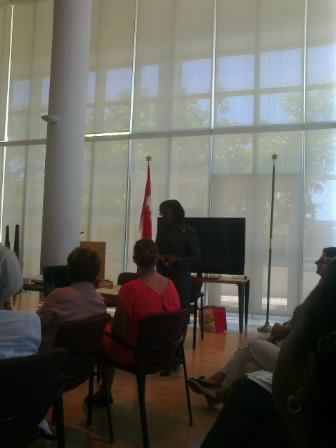
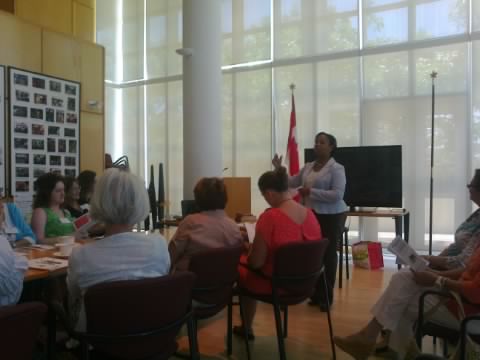
Dress for Success is an international non-profit organization that provides workplace-appropriate clothes for women who don’t have any. “When we look the part, it makes us feel so much better,” says Minette Bryan of Jamaica’s chapter of Dress for Success. Ms. Bryan, along with colleague Nadine Chambers, presented their mission to the Canadian Women’s Club this morning in a bid for support for their fledgling organization.

Jamaica’s chapter is the first in the Caribbean and joins about 135 other countries that already provide this service. Essentially, Dress for Success outfits women who may just be entering the workforce or who may have left and need to rejoin but lack the resources to do so. In addition to suits and accessories, Dress for Success in Jamaica has started to offer workshops on topics such as life skills, as well as a Career Development Center.

The target age group is 18-60 and in 2013 alone, Dress for Success provided over 150 women with an outfit and already this year, more than 50 women have received support. “We want to empower women,” Bryan said. The Jamaican chapter was started in 2008 and is quickly gaining steam, with more than 50 volunteers engaged, who provide mentorship and advice to women who are referred by university career centers, crisis centers, vocational training facilities and the Women Foundation of Jamaica. “We prepare them for the work world,” said Nadine Chambers, who works almost full-time for Dress for Success, in addition to her full-time career.

The last career training session welcomed 31 women and five men (while Dress for Success does not officially cater to men, they will not turn them away).

Officially, their mission is to “promote the economic independence of disadvantaged women by providing them with: professional attire; a support network and career development tools. We promote the economic empowerment of women ages 18-60 so they can thrive in their careers and in life.”

According to Dress for Success, some clients are single mothers who are raising two or three children. In addition, 80 per cent are college or university graduates who cannot afford a suit (most live under the poverty line) and range in age from 18-38.

This kind of service highlights that which many of us take for granted everyday: that we send out a resume, get a call for a job interview, do our research, put on our best suit and then find our way to the right place at the right time.

If you want to donate cash or clothing, you can call them at 876-547-4356 or find them on Facebook.

Jamaica 43rd on Social Progress Index


There are many ways a country can measure the well-being of its citizens. Gross Domestic Product is often a benchmark economists, politicians and lawmakers use to measure health, happiness and prosperity. The United Nations Millennium Development Goals are perhaps the best known and most adhered to internationally.

However, many of these means of measurement come under fire from people who say they do not take into account too many crucial factors. As a result, when governments and civil society organizations attempt to target the most needy, they start from a skewed and faulty foundation, as the data is not accurate. Such is the argument. (Check out this interactive graphic from the Guardian that does a good job of explaining the MDGs, their successes and shortcomings).

In any case, my attention was captured by a relatively new organization that has created the Social Progress Index. Their premise is that economic indicators are insufficient to measure social progress. In other words, economists fail to take into account many indicators that can measure how healthy and happy people are.

From their website:

Social progress is defined as the capacity of a society to meet the basic human needs of its citizens, establish the building blocks that allow citizens and communities to enhance and sustain the quality of their lives, and create the conditions for all individuals to reach their full potential.

The Social Progress Index is a tool that we hope will be widely used to inform and influence policies and institutions around the world. The Index is founded on the principle that what we measure guides the choices we make. By measuring the things that really matter to people — their basic needs, their food, shelter and security; their access to healthcare, education, and a healthy environment; their opportunity to improve their live — the Social Progress Index is an attempt to reshape the debate about development.

The Social Progress Index was incorporated as a non-profit in 2012 and seems to have involved a Harvard Business School professor, an Economist bureau chief and funding from the Skoll Foundation and the Rockefeller Foundation, among other notable names and organizations.

And here are the indicators they measure:

Basic Human Needs
Nutrition and Basic Medical Care
Water and Sanitation
Shelter
Personal Safety
Foundations of Wellbeing
Access to Basic Knowledge
Access to Information and Communications
Health and Wellness
Ecosystem Sustainability
Opportunity
Personal Rights
Personal Freedom and Choice
Tolerance and Inclusion
Access to Advanced Education

So how does Jamaica fare? Surprisingly, Jamaica does well when it comes to providing Nutrition and Basic Medical Care, Access to Basic Information and Personal Rights. (I am not sure I agree with those, from my experience, and would be interested to know what kind of on-the-ground research occurred.)

Also not surprisingly, Jamaica can improve on ensuring Personal Safety, Ecosystem Sustainability and providing Access to Advanced Education.

Below are some other stats, ranking Jamaica in comparison to 131 other countries. The social progress index is a score out of 100, and if you want to know more about their methodology, check it out here. What struck me is the assurance that the index excludes economic indicators and measures what matters in the lives of real people, to use their terminology. But here is more about how Jamaica fared:

Social Progress Index 70.39 (43rd)
Basic Human Needs 69.23 (76th)
Foundations of Wellbeing 76.34 (31st)
Opportunity 65.60 (30th)

Population (2011) 2,712,100 (118th)
GDP (PPP) $ 7,083 (73rd)

For the record, the top three countries are New Zealand, Switzerland and Iceland, while Chad is the worst. I suggest you take a look at the dataset, it is very interesting and offers a new way to measure progress and well-being.

The threat of apples


I was just trying to be honest. I was in Toronto, clearing customs on my way back to Kingston via Miami. Fueled by a little paranoia and a healthy respect for immigration regulations, I answered honestly when the U.S. customs agent asked if I had any food.

“Yes,” I said, “my lunch, some bread and an apple,” I managed to say. “You will have to have the apple inspected,” she said sternly. I have had food confiscated before because of security requirements (yoghurt is apparently a risk over three ounces), but never because of NAFTA or some obscure trade regulation.

So I ventured off to the inspection area (behind some double doors), where three male agents were standing behind different stations. A Spanish-speaking woman was being questioned while a man in a grey suit attempted to steer a luggage cart with several suitcases to another agent.

I waited awhile and no one acknowledged my presence. So I walked up to a free agent and asked if he could inspect my apple. He did and promptly told me I would have to throw it out because it didn’t have a sticker indicating that it is either from Canada or the U.S. My poor apple was then dumped in a cardboard box with a lot of other sad-looking food. I was surprisingly upset: it looked like a delicious apple!

Then I got to thinking: these arcane, obscure and complex rules are drafted by international trade lawyers and bureaucrats in some office or at a summit with the best of intentions. Perhaps to protect local farmers or encourage trade, and here is how they are manifested. Good food literally becomes garbage, doing no good to no one except the vendors.

Is this how the politicians and bureaucrats envision success when these trade deals are signed at press conferences? I tried to do a bit of research and have come up short. Some web sites tell me you are allowed to bring in fruit from November to April, while other say it is prohibited at all times. Who knew there were so many rules? I ended up buying another apple on the other side, which was rotten in the middle, by the way, and sure enough, it bore a sticker saying it was the product of the U.S.

In any case, this incident served to remind me of the disconnect between the bureaucracy and the human beings who are ensnared in it, despite all good intentions.

Parsing Vybz Kartel’s Sentence


Vybz Kartel has received a life sentence. This is big news in JA. Read a great account here.

ap's avatarActive Voice

Often in the course of his prolonged trial I found myself wondering if the rollercoaster life of Adidja Palmer aka Vybz Kartel was scripted by someone inspired by Breaking Bad, the wildly popular American TV series about the rise and fall of a chemistry teacher turned meth dealer.  By the time the trial ended I knew it was nothing of the sort, just another wildly original Jamaican libretto. Described by some as the country’s pre-eminent lyricist, for more than a decade Kartel ruled the roost in Jamaica as its reigning dancehall deejay (”a genre that is to the roots reggae of Bob Marley as hip-hop is to R&B”), his street cred extending far beyond Kingston, into the nooks and crannies of ghettoes all over the Caribbean, into urban America and as far away as Africa where his Gaza Empire has spawned copycats.

By late 2013 Vybz Kartel, 38, was being…

View original post 2,956 more words

Happy 100!


My beautiful grandmother turned 100 today. Grace is her name and she was born in 1914.

Triple P for Canada and Jamaica?


Interesting timing for this story. Jamaica and Canada (and the rest of the Caribbean nations that are part of CARICOM) are currently negotiating a free trade agreement. According to my sources, negotiations are not going well. Canadian High Commissioner to Jamaica Robert Ready is the lead negotiator at this time.

But the Gleaner today runs this story that while Canada is cautious about doing business with Jamaica, the potential is there for more PPPs. That is to say, public/private partnerships. Triple Ps have been popular lately as the public sector attempts to finance large-scale projects with a minimum of up-front investment. That is where the private sector comes in- as a partner to carry the initial investments. In return, the private sector gets to own and/or operate the project or asset (there are many different configurations) and the public gets their new bridge/hospital, what-have-you.

Reactions to PPPs are mixed and usually fall along partisan lines. In any case, it is interesting indeed that Canada appears keen on PPPs with Jamaica whilst some tough negotiations with CARICOM are ongoing. Perhaps Canada is more bullish on Jamaica’s future but reluctant to sign onto the new CARICOM agreement. I am not familiar with the details, this is just speculation.

In any case, this Gleaner story illustrates Canada’s approach to doing business with Jamaica. The initiative is being led by Canada’s Export Development Corporation. From the story:

Export Development Canada (EDC) was formed more than 65 years ago to help Canadian companies export products and services and invest internationally.

The agency has already funded large businesses in Jamaica. In 2012, EDC helped finance a Digicel telecommunications equipment project with up to US$250 million and a smaller Jamaica Public Service project involving the sale of various Canadian goods and services for up to US$25 million.

There are some countries that the EDC “will not lend to”, due to the level of risk, said Rick McElrea, senior trade commissioner at the Canadian High Commission.

“Jamaica isn’t one of those,” McElrea said at a workshop hosted by the high commission in Kingston last Thursday.

However, “EDC would be cautious in dealing with Jamaica at this stage,” the trade commissioner said, but would mitigate that risk by partnering with local banks, including Canadian banks in Jamaica, he told the workshop.

Slightly dry topic, but it is important. Enjoy your day.

April 1 raid


April 1 is apparently the deadline for the police, headed by Inspector Murdock, to perform a “raid” and force the young men out of the gully. This is where they live as they are disenfranchised from society and rejected by their families.

A judge recently ruled against an order to have them evicted, as it is a public place, but the police insist that their occupation is a health hazard.

On Saturday night, the final night of high school athletic competition Champs, the police chose this time to warn the guys that they will be forced to leave. (Read another account of this evening here.)

In terms of avoiding the further inflammation of the situation, this could not have been a worse time. I was driving by and witnessed throngs of young men and women walking by, some of them clumped around the gully. I heard several calls of “batty man” (a derogatory term for a homosexual) and a lot of yelling and excitement. The blue lights from the police cars were flashing all over the place. Apparently this visit by the police was to warn the guys that they will be evicted. However, they have absolutely nowhere to go. Shelters are unsafe, their families have generally disowned them and they have difficulty securing employment to support themselves.

A group called Dwayne’s House is trying to raise money to house these young men and the Colour Pink Group is trying to fund some employment training. In the meantime, however, the situation seems to be escalating in the wrong direction. Where do the police and authorities think these young men will go? Why are they not concerned with protecting society’s most vulnerable citizens? (It must be pointed out that some of them engage in antisocial behaviour and criminal activity to support themselves, but they have had little or no opportunity to be “socialized” properly so that they can operate in the normal channels that you and I engage in to support ourselves).

I ran by the gully this morning and the guys were still there. Apparently a couple of them have been taken into custody and the raid will happen sometime today. The international media has also taken note. Channel 4 from the U.K. was filming a scene when I passed by.

Let’s hope that no one is injured today and that the police and/or other authorities have a plan to protect these vulnerable members of society.

Twitter diplomacy


Check out the latest newsletter from Cuso International. It highlights the organization’s latest activities in the region.

Cuso International Partner Newsletter March 2014

On a similar note, you must read this speech from Foreign Affairs, Trade and Development Minister John Baird. He is urging Canadian diplomats to engage in social media to communicate with the rest of the nation and beyond. This is one of the most well-rounded articulations of Canada’s commitment to human rights I have heard and/or read in awhile. I’m not sure of the timing, and why this articulation had to be folded into a less weighty topic, but it is welcome.

Challenging and confronting those who threaten freedom, democracy, human rights and the rule of law: this is where I want to see this department and our representatives abroad distinguish themselves. And as we think about what we want to say and do, it’s just as important to think about how.

The ways in which we exert an influence on the world are rapidly changing. If I was a young ambitious foreign service officer in 2014, I’d be thinking about gaining an edge in communications skills. Diplomacy is increasingly about public advocacy. You can have the best product in the world. But if people don’t know about it, if it’s not marketed, then what’s the point?

Hmmm…Canadian foreign policy as product to be bought and sold? Interesting approach, but not uncommon now. This also seems incongruous with the tight hold the Harper administration has put on bureaucrats. Here’s more from the speech:

That means being able to condense a message into 140 characters. That means finding creative, interactive, visual ways of promoting a message. That means writing and speaking in a language and style that persuades people, rather than just relaying information. Because ultimately, behind all this technology it’s all about people, and relationships. That’s how the world works.

That’s why we have greatly increased the number of roles that require foreign language fluency. And that’s why I’ve travelled over one million kilometres since becoming Foreign Minister; not because I enjoy plane food.

We’ve traditionally been good at working with people behind closed doors, now we are applying those skills to the very public arena of the digital world. Networked technologies make it easier than ever for people all over the world to share information and ideas, to assemble and organize, and to shape the course of global events.

Diplomacy is not immune to these changes. Governments are no longer the sole dominant actors in international affairs. As I said when I visited Silicon Valley last month, the closed world of demarches and summits still have a role. But in the age of viral videos, ‘twiplomacy’ and mobile apps- the old levers are no longer enough.

A lot to think about. Enjoy your Monday.