Good Friday morning! The quality is not very good, but here is the video of Tessanne performing at the White House the other night. Congratulations!

Good Friday morning! The quality is not very good, but here is the video of Tessanne performing at the White House the other night. Congratulations!
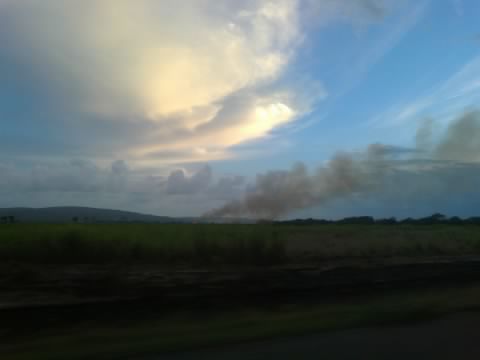
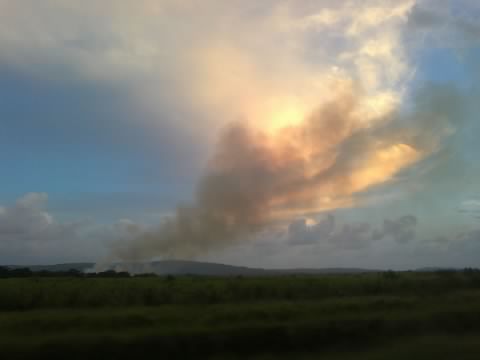
Yesterday during an evening drive I was witness to a gorgeous sunset, but as we traveled west, it became marred by a large plume of smoke. As we approached the area, it became clear that a farmer was burning a crop. I was told it was sugar cane. Why would a farmer burn sugar cane, I wondered.
A bit of research later, I have discovered that farmers do this to more easily access the usable part of the sugar cane. The fire reveals the stalk and eliminates the refuse created by the machinery that otherwise would handle the harvest. Burning the crop also reduces the costs associated with harvesting because this expensive machinery is not required.
However, Jamaican farmers were apparently supposed to stop this practice by 2014. Not surprisingly, the smoke is a pollutant and many other nations are attempting to phase out the practice. I don’t know the latest on the government’s actions related to this issue, but obviously farmers are still getting away with burning their crops.
Sugar cane, of course, played a large role in Jamaica’s growth as a nation, but its dominance has since diminished. (Forgive my wikipedia reference, but in this post I am simply sticking to the agricultural rather than social implications of this industry). The plant can reach up to 4.5 metres and about 30,000 hectares of land in Jamaica is devoted to its growth. The industry employs about 30,000 people, and heavy machinery like crawler tractors and harvesters are used to prepare and reap the crops, which is then sent to a refinery. Up to 600,000 tonnes of crop is produced on an annual basis, yielding 65,000 tonnes of sugar, according to an industry web site. The crop must also be transported across Jamaica, which was previously done by railroad, but the system was halted in 1967 and now it is all done by truck.
Unfortunately, it seems that the industry is suffering and it appears that there are several groups focused on sugar cane refinery. I guess we must stay tuned to see how the government will regulate this once-lucrative industry.

It is a holiday here for Ash Wednesday. This is a shot from Lime Cay of the Harbour I took awhile back. I ran up a hill this morning and did a boot-camp workout, now going to try to relax and not do any work. Enjoy your day.

I am wearing blue today and I noticed a number of people doing the same on my run this morning. The reason for this co-ordination is that it is Peace and Love Day, an initiative by the Peace and Love in Society organization, which urges people today to wear blue in support of a non-violent environment.
PALS was established 20 years ago to implement conflict resolution programs in schools and create strategic alliances between government and civil society. Unfortunately, it appears that the introduction of the curriculum still has not happened. The organization is still pushing its effort to add extra time for conflict resolution training during the school day, and to date, it has trained 200 police officers to work in schools.
Here is an excerpt from the PALS web site:
This year’s Peace Day theme is “A Peaceful Resolution is the Best Solution.” We know how hard it is in today’s Jamaica to ask our children to choose non-violent solutions when they get daily messages that when people have a conflict, violence is the best method to resolve it; that fighting is normal and acceptable – and even fun; that in every conflict there is a winner and a loser. We also know that schools are a major influence on behaviour as teachers strive to teach children to treat others respectfully and to resolve conflicts without violence.
Peace Day activities include a scripture reading and a theme song, and of course, wearing blue. There will also likely be a word from Peace Day ambassador Shelly-Ann Fraser Pryce. Enjoy your day and remember that love is always the answer.


One quarter of the world’s population suffers from mental illness. This is true for Canada, the U.S., and Jamaica.
In general, the supply of mental health services around the world has not kept pace with demand for treatment, especially in comparison to the attention paid to physical disorders. There are many reasons for this, the main one being the stigma that remains for people suffering from mental disorders. It is still considered something to be ashamed of in most cultures. In fact, it is still acceptable to find humour in someone suffering from a mental disorder.
Take this advertisement that ran in Jamaica’s Gleaner yesterday. An attractive woman appears bound by a sanitized version of a straightjacket. I think the audience is to infer that she is locked up in the mental asylum, to put it crudely. “Good reason to lose your mind. It’s March Madness!” reads the copy above the picture.
As someone who has nearly lost a loved one to mental illness several times, I do not take this lightly. Would the advertising company executives have approved a picture of a woman suffering from a physical disease to sell a good deal for eyewear?
Had they known these facts, maybe they would also reconsider:
There are roughly 500,000 people in Jamaica suffering from mental illness.
The number of patients on the books of the community services has increased from 7,779 in 1995 to 10,907 in 2000.
(From this report by Dr. Kwame McKenzie:) There are a limited number of residential facilities. Most of the funding is currently being channelled to the mental hospital.
There is a dearth of local quantitative and qualitative researches on mental health issues
Shortages of staff such as psychologists, occupational therapists, social workers with mental health training, mental health officers including those with child & adolescent training.
Mental Health data collection system. The PAHO had sponsored the purchase of a software to improve the system, however there is an urgent need for approximately ten (10) data entry clerks to be contracted for six (6) months to input the more than 11,000 patients data on the software at a cost of US$10,000. A request was made to PAHO but it was not supported. Efforts to identify funding from other sources have not been successful to date. Hence the reports from the officers in the regions continue to be late and inaccurate.
Inadequate number of ambulance type vehicles for the Psychiatric Emergency, Crisis, Assertive Outreach Home Visit Teams.
Clearly, there is a lot of work to be done in terms of how people with mental illness are treated here in Jamaica, and worldwide. A first step could be to re-think the language we use and what we accept from others, including advertisers, as permissible.
The Government is working on the Mental Health Act, which was last amended in 1999, to reflect increasing demand for adequate services. However, the country is in contravention of international law when it comes to the provision of services.
In Jamaica, and worldwide, it is a work in progress, how we treat those suffering from mental illness. The heavy lifting is being done by governments and civil society, however, we can incorporate it into our daily lives. For example, do not use the words “insane” or “schizophrenic” to describe something outrageous. And do not accept the use of someone suffering from mental illness to sell products.

Sunset in Negril. Enjoy your Friday.
On May 22, 2009, a horrific fire at Armadale Juvenile Correctional Facility in St. Ann killed 7 girls and injured 13 others. In this state-run facility, 23 girls shared one room with seven beds. They had limited access to sanitation facilities, were confined indoors for the majority of their time and were provided with very little in the way of education, stimulation or regular, nutritious meals.
The seven deceased were named Ann-Marie Samuels, Nerrissa King, Rachael King, Kaychell Nelson, Shauna-Lee Kerr, Georgina Saunders and Stephanie Smith and were all between the ages of 15 and 17. The fire was allegedly started by a guard who set it in response to being rejected by one of the girls. The injustices of this situation are innumerable, starting with the fact that the majority of these girls were confined because the state declared them “uncontrollable”. This term, which the government has since promised to strike from the legislation, allowed judges to remand youth to custody for minor “offences” such as running away from home. Further to this unjustified and arbitrary designation by the state, according to reports, the girls had been “locked down” for three weeks and could not escape because of this.
The conditions in the facility also contravened international law as they did not meet the United Nation’s Beijing Convention, which sets out minimum standards of care. (Read a report on the issue from Jamaicans for Justice here).
Last year, I did a report on juveniles in state care for 18 Degrees North (skip to second clip in link) and during my research, met one of the survivors of the fire, Candene. She is beautiful and brave and humbled me with her courage. She now makes her way through life with thick scars on her arm and burdened by the trauma of the fire and seeing her friends perish. She also advocates for herself and her peers. (Read a report of the fire from a survivor here.)
Jamaica’s Office of the Children’s Advocate is now seeking compensation from the government for the victims of the fire. It seems they have been reaching out for several months now, with newspaper advertisements and perhaps other means, without success. I know from my research that it is hard to locate these girls, as many do not have regular access to a cell phone or live in rural areas. In addition, their justified lack of trust in the government likely means they are reluctant to contact a state agency. However, they are due compensation and justice, although I suspect that no apology or monetary figure could ever make up for what they experienced.
I was able to speak with Nicole Wright, a lawyer with the Office of the Children’s Advocate. She told me that to date, NO girls represented by the OCA have received compensation. The OCA is in the process of going over previous similar cases, drafting estimates and presenting them to the Ministry of Justice. So far, the Ministry has rejected all of the OCA’s proposals. They are “far less than what we have asked for,” says Wright. “We have not settled any yet and we are not accepting” the figure that the government has come back with, she says, adding that it is a challenge to quantify the damages and trauma the girls experienced.
Wright admits she is having trouble locating some of the girls, some because their phone numbers have changed, others have moved, and some just don’t want to deal with the state or they are concerned about people in their community thinking they will receive a lot of money. “That is very disturbing to me,” Wright says.
By the numbers, there were 61 wards at Armadale when the fire occurred; 23 in the “office dorm” and 38 in the “cottage dorm”. The OCA is currently representing five of the deceased, and 55 girls in total. It has filed claims for 33 girls (some have signed the witness statements but some have not been located yet) and four other girls are represented by private lawyers. Two girls represented by private attorneys have received compensation. The trial will occur between July 7 and 18 of this year.
If Ms. Wright could talk to the girls she cannot locate, here is the message she would give them: “We would love for you to come in and talk to us, even if you are not interested (in compensation),” she says, adding that the OCA was established to represent children.
I leave you with this message from the equally brave and beautiful Moira Morgan, who founded The Griffin Trust, has worked closely with many of the survivors. Moira has taken them in like they are her own family, unconditionally. I also interviewed Moira for the piece I did and her commitment to these girls and her fierce drive to protect them was evident in the tears she shed during the interview.
I am putting a shout out to all my Armadale girls those i met at Diamond Crest and those i never got to meet. on a very serious note all the girls from both dorms who need to contact the Office of The Children’s Advocate, urgently……. Call 948 3771 ask for Nicole Wright,
All the girls have an entitlement to some compensation, and the packages are now being worked on……. but you need to sign up with the OCA NOW… they have a close off date of tomorrow for your registration, after that it will take longer again to sort it out. Call them on
Some of you know some others, please come forward……. you can call me on 868 **** ……… Don’t lose out and don’t let others lose out…….. even if you never like them
Candi Cane, Sherice Osheen Flemming, Lafaine Smith, Erica Blackbeauty Samuels, Samantha Meggo, Ashanti Ukkubit Sotightlyblessed, PLEASE SPREAD THE WORD…. THIS IS FOR REAL……
I have been a volunteer with Cuso International for almost two years now in Kingston, Jamaica. In addition to the work we carry out on-the-ground, we are also responsible for raising funds to help support the organization. I have just been alerted to the fact that Cuso is facing a $100,000 shortfall for the fiscal year, which ends March 31, 2014. And I would like to continue to try to do my part to raise funds to support this wonderful organization. I have raised some of the $2,000 we commit to, but still have a ways to go. Please visit my personal fundraising page and donate if you can. You can learn more about me and what Cuso does around the world.
Over the past couple of years, Cuso (along with many other groups in the international development realm) has faced financial uncertainty as the Canadian government reconsiders its foreign policy and its larger role on the international stage. Of late, the Harper government is shifting its foreign policy such that it is fueled more by economic interests than with previous administrations.
I am biased, of course, but I strongly urge you to donate to Cuso so that it can continue the wonderful work it is doing around the world. Thank you in advance for your support.

My route to work consists of one coaster bus and then a route taxi at a cost of $100 each (about $1.00 US). Lately, because of a crackdown by police on PPVs, (public passenger vehicles) they have been less insane and more placid. This means less night-club decible-level music blaring, less aggressive driving and less tinted windows. I almost miss the chaos but appreciate the relative increase in safety and predictability.
The route taxis, however, have still not been subjected to a crackdown, so they remain rickety and continue to careen and swerve down Kingston’s main roads. It has become a habit for me to lock the door if I am squished against it, since five or sometimes more people are packed in, thus testing the capacity of the vehicle.
In any case, this morning I was treated to luxury: a clean, new route taxi with tinted windows, air-conditioning and a television playing R.Kelly/Isley Brothers videos. Lovely.

Yesterday’s front page of the Jamaica Observer featured this headline and picture. It was certainly eye-catching. And then I read the story and was creeped out. According to parents Linval Grant and Vicky Forrest, their twin girls (aged 17 months), have woken up bloody, bruised and with bite marks on their skin. In addition, the family has seen “baby sized” figures in their home.
From a journalistic point of view, I cannot understand the newsworthiness of such an article. It seems more voyeuristic than anything. This is a destitute family, living in a “rotten” home that is infested by rats and even mongoose. Towards the end of the story, the family says it needs money.
Would this story have been written or made front page if it had been a wealthy family? I’m not sure. The newspapers here seem obsessed with portraying people from lower socio-economic classes in a certain way that is voyeuristic and reinforces the notion of the poor as “the other.”
We will likely never know the explanation behind these strange occurrences in this story. Maybe the Observer will follow up, maybe they won’t. Perhaps people will even offer support after reading this story. This has happened before and can be one positive outcome of the media focusing on the plight of poor people.
One could even argue that this article was written in a relatively respectful way in that it tells the story in a straightforward manner, ie it is taken as fact. However, this is also a drawback as there is no verification, no clarification, no other voices that could lend possible explanations. As a result, the audience is left wondering about the point of the story and left to fill in the blanks.
In any case, I am preparing to do some media training, so thoughts of newsworthiness and media ethics are on my mind. This article certainly provides some food for thought.

