Unknown's avatar

About Kate Chappell

"And all I offer here is the distilled poetry of my existence..." Claude McKay, Poet Laureate of Jamaica, 1890-1848 I have been a reporter since 1998, covering mainly business and politics. I have also capitalized on the many skills journalism requires to become an all-around communications specialist. In addition to being a professional curious person and communicator, I have a bad case of the travel bug and can't seem to stay put. Finally, I have put my skills to work as a volunteer in the community wherever I have lived. Now, follow me as I combine these compartments of my life in Kingston, Jamaica, where I am a writer, reporter, journalist and lecturer.

Children’s Treat in Jacques Road, Mountain View


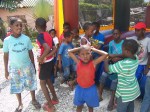
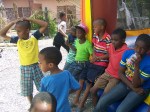
Yesterday, dozens of children in the community of Jacques Road in Mountain View turned out to enjoy a bouncy castle, mini-merry-go-round, some presents and good food. Hosted by the Jacques Road Parenting Association, the treat for the neighbourhood’s children was held at 63 Mountain View Avenue in partnership with the Social Development Commission and other contributors such as Lasco and the Bashy Bus. CB Chicken and Food for the Poor provided generous donations of food for the children. The Tax Administration of Jamaica were also present to register people for a Taxpayer Registration Number, which is an important component of citizenship in Jamaica.

The community of Jacques Road, under the leadership and guidance of Ann Marie Lynch and Pastor Francena Pryce, has made great strides in reducing crime and violence, poverty and teenage pregnancy. Pryce and Lynch have worked hard, and they also attribute the positive changes to the presence of Youth Opportunities Unlimited, which originally started working there in 2003.

Yesterday’s event saw hundreds of people from the community attend to watch the children have some fun and enjoy some treats they don’t usually get. And there was no mistaking their delight: shrieks of joy, smiles and even patience as they waited for their friends to finish their turns on the rides.

I was also able to catch up with Jovan, a talented young poet and writer who continues to practice his craft while working at Burger King since November. He is one of the community’s young leaders and continue to work hard to achieve his goals.

In addition to this children’s treat, Jacques Road is celebrating a milestone with the founding of its Parenting Association. It will also officially open its Internet Cafe this Wednesday, which was built in part with help from the Canadian Navy, and celebrate its new and improved Homework Centre. Stay tuned for a report on this and enjoy your Sunday.

Kingston’s roads blocked, not for Kartel’s trial, but for hundreds of children


Yesterday I had to venture downtown to collect a document. As I wrote about yesterday, the murder trial of dancehall artist Vybz Kartel is ongoing, with the verdict expected any day now. (It is suspended today:

As a result, police have blocked off roads and are standing around on corners and setting up tents on roofs and carrying high powered weapons. Or at least this was the way the media presented the situation yesterday.

However, as I made my way down the narrow streets, it was eerily calm and quiet. I’ve never seen it so peaceful downtown, in fact. It is usually a lively, crowded place full of office workers and vendors. There was definitely a strong police presence surrounding the Supreme Court, but the barriers had been taken down. Perhaps this was an attempt to de-escalate the situation, or perhaps it was in response to the fact that it seems the decision will now be delivered next week and today deliberations are suspended, as indicated in the tweet above.

In any case, I retrieved my document and walked over to the Supreme Court to see what was going on. Not much, actually. It looked the way it always does. I then caught a route taxi out of the downtown core, and quickly hit some major traffic. Vehicles were at a standstill, which is not unusual, but I saw the cause: hundreds of children in navy blue uniforms walking, holding signs, chanting and marching.

I abandoned my taxi and started to walk with them. It turns out it is Founder’s Week for the Scout Association of Jamaica. I chatted briefly with one woman walking beside the children, who were walking in rows of three, holding hands and sweating in the sun. They were on their way to the Governor General’s residence and had been walking miles. Literally miles in dark uniforms in the mid-day sun. In any case, it was a delightful diversion and quite a sight to see- hundreds of children walking on Kingston’s main roads, blocking traffic. This is a preferable alternative to roads being blocked by barriers that are erected in anticipation of confrontation between Kartel supporters and authorities should he be found guilty.

Kartel trial set to end any day


Streets are sealed off downtown and police are forming barriers with their bicycles in order to block citizens from getting close to the Supreme Court. The reason for this is that the trial of Adidja Palmer, more commonly known as dancehall artist Vybz Kartel, is set to end any day now.

Kartel is on trial for murder and has been incarcerated for 30 months. Although he comes from a relatively comfortable upbringing in Portmore (which is the equivalent of a suburb of Toronto), Kartel is like a folk hero to many people in Jamaica. To be specific, he is a hero to people who don’t come from the wealthy “uptown” neighbourhoods, to the people who don’t trust that the police have their best interests at heart. And despite the fact that he has been incarcerated for over two years, his music remains popular, blaring from coasters and taxis and new singles being released at a torrid rate. (In fact, he put a triple album out late last year).

People are already gathering in anticipation of the verdict and some are picking fights with police. Their comments (from the Gleaner article) are telling:

“Kartel! Kartel! World Boss rule di place!” screamed an elderly woman, as police personnel armed with high-powered weapons and pepper spray came out in their numbers, seemingly well prepared. Some civilians, including attorneys, complained that the law-enforcement officers were overreacting.

The shouts of the numerous fans who gathered in downtown Kingston to pay homage to the incarcerated entertainer under punishing heat grew louder as the cops pitched tent on the roof of the Supreme Court, with high-powered weapons in hand.

An elderly woman complained that there was no reason for the large gathering of fans or police as the embattled entertainer was not as big in stature as the senior Coke.

“Him no big like Jim Brown, so why should so many policemen come out?” she said.

Commentators state that the trial is more about fighting “Babylon” and the “system” than it is about Kartel himself. And this seems to be true, judging by the type of people showing up downtown (tattooed, bleached young people). Read a couple of perspective here and here.

Whatever the verdict, let’s hope that downtown remains peaceful, wherever the world boss ends up.

JSPCA


I’ve been trying to write a coherent blog post for too long this morning, but it’s not happening. The reason is that I’m thrown off today by what I witnessed early this morning. I was returning from a workout (under the moon and stars at Jamaica College) with a running group. We received a plyometrics training workout from a strength and conditioning coach from London, who is in town training some Jamaican athletes.

In any case, I was almost at home, running on Hope Road, when a black and white dog darted out in front of me. It came from a side street out of nowhere, and unfortunately, a Jamaica Defence Force truck slammed into it. The sound was a loud, sickening bang and then I saw the dog trying to get up from under the front right tire. It eventually bounced back up and sprinted away, back into traffic. It seemed ok, but I don’t think it is. Adrenaline was probably numbing the pain, enabling it to run away. I am still deeply disturbed even though this happens countless times every day in Kingston.

There are thousands of stray dogs, skinny and listless, in Jamaica. It is heartbreaking. They lie around on the sidewalks, scavenge for food and generally leave people alone because they are too malnourished and starving to interact with people. The Jamaica Society for the Prevention of Cruelty to Animals tries to do its part, but it just can’t keep up.

The JSPCA has been around for more than 100 years and helps over 300 animals per week, according to its web site. The shelter is located right near Half Way Tree (near my apartment actually, in fact, sometimes I hear the dogs barking) and is equipped with a maternity ward, an isolation unit, a laboratory and surgical suites. There are also four vet techs and three veterinarians on staff. They do some good work. If you want to donate or volunteer, click here.

Police forces still protecting planation masters in JA, says Police Superintendent


In terms of socio-economic status dictating who floats to the top, who settles at the bottom and all those who rest somewhere in the middle, class competes with skin colour here in Jamaica. That is to say that where you went to school, what your parents do, how much money you have, what car you drive, what parties you go to and what your job is are factors that are just as, if not more, important than skin colour. I have been in numerous meetings during which, upon introductions, people question one another about their provenances. There is then a moment of appraisal as people decide where their new acquaintance falls socially and then everyone behaves accordingly.

Of course, this is not unique to Jamaica. Neither is the fact that people do not like to talk about it. That is why these statements from a high-ranking officer are so remarkable. Superintendent of Police Fitz Bailey the other day spoke bluntly about this phenomenon, as it has proven detrimental to vulnerable members of society.

Read the full article here from the Gleaner.

Senior Superintendent of Police Fitz Bailey, in charge of the St Andrew Central Division, believes classism in Jamaica is an obstacle to the nation achieving justice and tranquility.

Bailey, who was a guest speaker at the Peace for Champs devotion held yesterday at the Church of God in August Town, St Andrew, reflected on the reason for the existence of the police force.

“The situation of the police force being created to protect plantation master still exists, and we have to change it,” said Bailey. “We see where (there is) inequity in the distribution of wealth, and there was never a time where we saw equal distribution of wealth. The minimum wage can hardly do anything for those who earn it.”

He added: “Every citizen in this country needs to be appreciated and feel a sense of belonging. Jamaica is not at peace; we are in a state of war. It’s about people understanding their purpose and being a part of society.”
Said Bailey: “We cannot have a just society where there is disparity.”

Broadcasting Jamaica to the world for over 30 years- Phase 3 Productions


Whether it is the sweet reggae music, spicy food or record-breaking athletes that define Jamaica’s culture, for more than three decades, one company has been instrumental in conveying this culture to its citizens and the rest of the world.

Phase 3 Productions started thirty years ago not as a business, but as a hobby, as Richard Forbes nurtured his love of video production in his Kingston home. Since then, it has grown into a multi-million dollar company that has broadcast some of the nation’s most important events. Ronald Reagan, George Bush, Desmond Tutu, Fidel Castro and the Queen of England were just some of the state visits Phase 3 produced. And then there are the landmark cultural events such as Summerfest, Rebel Salute, Jamaica Jazz and Blues Fest and sports such as the Jamaica Athletics Association’s World Championship, the ISSA Boys’ and Girls’ Championships and the CONCACAF Under-17 Women’s soccer competition.

This year marks three decades that the Forbes family, consisting of Marcia, Richard and son Delano, have owned and operated Phase 3 Productions in Jamaica. It now employs 100 freelancers and a full-time staff of 25 people.

Phase 3’s roots originate from Richard’s love of technology and his dabbling as a DJ. “It very, very quickly grew into a real business,” says Marcia Forbes during an interview in her colourful office.

Its first ventures included three JBC television shows (Sports Spotlight, to mention one) and music videos for Lady G, JC Lodge and Lovindeer. And Phase 3, through Delano’s work on music videos, also produced Voice winner Tessanne Chin’s video for Hideaway. Delano also won the Caribbean Broadcasting Union’s Best Video of the year for three years straight.

In the early years, business started to take off as the government-run public broadcaster Jamaica Broadcasting Corporation (JBC) began to rely on Phase 3 to transmit events. “The JBC’s outside broadcast unit broke down, so they commissioned us to do national events,” says Forbes of one of the company’s first challenges. Forbes recalls another particularly difficult day, when Phase 3 had two outdoor events at opposite ends of Kingston scheduled, and only one mobile broadcasting unit. “All our vans had flashers, and we were driving from downtown with our flashers on with someone hanging out the van and a police escort. We managed to set up before the JBC,” she recalls with a laugh.

Fast forward to present-day. In 2012, Phase 3 produced 323 hours of local content, almost half of which was carried on live television, and 2013 exceeded 500 hours. Phase 3 has also worked with other international channels (NBC’s Telemundo, Televisa, TV Azteca, beIN Sport and Traffic Sport) and has broadcast the live stream to Brazil, Japan, the USA, the UK and other countries in Europe and Africa. The company’s clients include Sagicor, Sandals, the Jamaica Observer LIME, Flow, BET, MTV, Viacom and the Bank of Jamaica. Phase 3 was also the official broadcaster for Jamaica 50’s celebrations at the Jubilee Village.

But of course, growing a business over three decades is not without a steep learning curve, Forbes admits. However, these challenges over the years have translated into wisdom and skills that are now relayed to Phase 3 staff and dozens of university students, who pass through as interns. In the past year alone, Phase 3 took on eight interns and hired three. And in celebration of the 30th anniversary of Phase 3, the company plans to formalize this training with a structure program for interns and newcomers eager to learn more about the industry.

Jamaica’s university students are not the only ones who learn on-the-job at Phase 3. Son Delano, who is now the Creative Director and CEO, got his start in the industry as early as age 5, when he acted in television commercials. By age 12, he was working with his parents at the company, rolling up cables and cleaning equipment, and at 16, slowly took on more and more responsibility as his father Richard lost his sight. In addition to this practical experience, Delano has academic qualifications to back it up; he has a BFA from New York University in Film Directing (with a minor in Economics) and an MBA from Florida International University.

“In terms of our field, without blowing our own trumpet, we act as a resource,” says Delano. “We are not just an equipment resource. It is not uncommon for us, even for jobs that we’re not working on, that producers will call us. Some people refer to us as a university because a lot of companies have come out of Phase 3. We have no issues at all with that kind of scenario. People who come here, we are all learning from each other. Lot of people know us for reinvesting heavily, for our hard work and for keeping up to date. Us being able to transition through the decades does speak to us in a good light.”

As does the company’s resourcefulness. “We have learned how to make do with very little,” Mrs. Forbes says, touching on the difficulties of doing business in Jamaica. “We have also learned that you are only as good as your last job. If you don’t deliver then you are chopped liver. Everybody wants to be the best, and entertainers are not always easy to deal with,” she says, adding that while the entertainment industry aspect seems “sexy” to outsiders, it is anything but. In fact, it is long hours, coping with the unexpected and accommodating many demands from clients.

(Read another good piece about the Forbes family and Phase 3 here.)

Perhaps the most substantial experience came with the live broadcast of Sting, which is an annual “clash” of words between dancehall artists. This year marked the first time that it was streamed live via pay-per-view to the North American market (93 million homes, to be exact). In a series of logistics way too confusing for those not in the industry to understand, four signals were broadcast to Las Vegas, where they were then picked up and relayed to American and Canadian homes.

While the event had a few glitches, it was deemed a huge success, and other businesses have come calling for Phase 3’s recipe. “From our end, in terms of the signal, it was highly successful,” says Forbes, adding that the live nature of the broadcast was relatively unprecedented.

The company plans to apply this method to other events such as major sports competitions, and they are even planning to provide the capability to stream them live to people’s tablets or phones. This level of innovation is not without sacrifices, however, Forbes adds. “We lost our shirt but not our pants,” she says of live streaming events, especially sports, but this takes a lot of resources. “There is a tremendous interest in live streaming athletics, but then you need customer service departments, you have to purchase the bandwidth, you have to guess or plan for the right amount of subscribers. There are many, many issues related to live streaming.”

It is, however, the way of the future, as is high definition television, Forbes adds. To this end, Phase 3 keeps its technology as up-to-date as possible. “We see our role as pioneers in content export,” Forbes says, adding that production is now mainly based on software. In the bigger picture, Forbes says Phase 3 is committed to remaining a foundational company in Jamaica. “We are committed to reinvesting and offering jobs to Jamaicans. There is a lot wrong with Jamaica, that is true, with crime and corruption being a double-headed monster, but despite the negatives, every cloud has a silver lining and we choose to look for the silver lining…We have been here for 30 years and we have some level of investment, so we are still relevant. We are proud of our longevity and we have not stood in the same place, while we have watched other companies come and go…We are totally committed to Jamaica. We don’t have one foot somewhere else. This is where we work and where we choose to live.”

Phase 3 now has eight high definition cameras and a $20 million (JMD) high definition field production truck. The company has also invested more than $300 million (JMD) in equipment and in 2012, acquired assets worth $55 million. Unfortunately, none of this infrastructure can be locally sourced, as it is not manufactured in Jamaica, Forbes adds, which is a “real opportunity cost. When we buy equipment, nothing we use is produced locally.”

All this acquisition is taking place in the midst of a dramatically changing market that is being shaped by social media and new technology, Forbes adds.

“The market has been revolutionized. You had big production houses and now everybody is a producer or content creator. The business model has evolved and we have embraced social media,” she says. Indeed, Forbes is considered a social media expert and has two books to back it up: Streaming: Social Media, Mobile Lifestyles and Music Media and Adolescent Sexuality in Jamaica. She also completed a Fullbright Fellowship at Emerson College in Boston some years ago, where she completed a Master’s degree in Global Media, Communications and Advertising. Forbes continued this education and is actually known formally as Dr. Forbes, as she completed her Phd in Communications at the University of West Indies.

So what is next for Phase 3? There have been rumblings about taking the company public, Forbes says, and in fact, some major financial firms have indicated interest in this prospect. “But we like the autonomy. We will expand and that’s the thrust of where we are going.”

(Full disclosure: Phase 3 provided complimentary passes to the 2014 Jazz and Blues Festival so I could get a sense of the scope of the company’s activities.)

Sigma Run


This morning marked the 16th annual Sagicor Sigma Corporate Run 2014. According to race organizers, 22,368 people took part, both runners and walkers. It is the largest race in Kingston and proceeds go to charity. To date, $118 million (JMD) has been raised for organizations that focus on children’s welfare.

The route is officially 5.5 kilometres and tracks through the corporate area. I have done most of the races now and this is by far the most popular, and therefore crowded. We were all packed into the main street, waiting for the gun to go off. There was about a half hour of speeches and ceremonial events, the highlight of which was the singing of the national anthem by Tessanne Chin.

The wheelchair athletes depart first, then the runners, then the walkers. It was a slow time for me but good to get back out there for my first race since the full marathon. I officially ranked 7th in my age group and 34th out of 6,203 females! Enjoy your Sunday.

Kingston at Night


Here is the view of Kingston at night from a place called Lookout at the top of Red Hills Road. Other than some dogs barking and cicadas making their noise, it is quiet and peaceful up there. The whole city is visible, from the airport to Portmore to the tall buildings of downtown. And it was a full moon.

Happy Valentine’s Day!


Happy Valentine’s Day! This is Flora the dog, who lives in Treasure Beach in Jamaica’s south-west parish of St. Elizabeth. We went out on a boat with Flora’s person Ted, who took us to the Pelican Bar and the Black River, where you can see crocodiles.

In this picture, Flora suddenly was aroused from her nap because she sensed dolphins. She felt them before we saw them and then they appeared to us, playing alongside the boat. I hope you are feeling as excited as Flora about someone or something in your life today. Enjoy your day!

Who was your mentor along the way?

Aside


How do you move a society forward? This is one of the fundamental questions Dr. Leslie Yaffa has pondered over the years, prompted by her research on mentoring and Jamaican youth. For close to two decades, Dr. Yaffa has devoted her efforts to the effects of mentoring on youth’s self-esteem and potential.

Dr. Yaffa first visited Jamaica in 1996 when she visited as a Master’s student doing her practicum, and late last year, visited Youth Opportunities Unlimited (along with several other volunteer organization such as the YMCA and YWCA) to begin a research project on the effects of mentoring in the Caribbean. Dr. Yaffa lives in Toronto and now works for the online University of New England.

Dr. Yaffa’s rationale for the research (for which she is waiting to hear whether or not she got a grant to continue it, which would involve partnering with YOU) is that mentoring is one of the most effective yet efficient ways of reaching youth. However, there is little to no research in the Caribbean, where YOU is one of the largest mentoring agencies in the region.

“The idea of mentoring is cost effective, first and foremost,” Dr. Yaffa says. “It utilizes the basics of social services like trust, bonding, rapport, advocacy, networking and volunteering service. It gives skills that kids don’t have.”

Not to mention the fact that these interventions, often with youth who have little support or guidance at home, can change a life. “You never know when one interaction and one intervention could change somebody’s path. If we think back, we all have mentors. Think back yourself, and recall that one teacher or coach who said those magic words that bolstered your self-esteem, that made you believe in yourself.”

Perhaps the biggest champion of mentoring is the Big Brothers and Big Sisters organization. Here are their vision and mission statements:

Vision: Children around the world realize their potential, creating a better future for themselves, their countries, and the global community.
Mission: To help children around the world reach their potential through professionally supported one-to-one mentoring relationships with measurable impact.

BBBS research shows that mentoring has real, tangible results: one study found that youth in mentoring relationships are 46 % less likely to start using drugs and 27% less likely to use alcohol. They are also shown to stay in school and earn better academic results.

President Barack Obama also urged citizens to get involved in mentoring in this year’s State of the Union address:

Mentors help children build confidence, gain knowledge, and develop the strength of character to succeed inside and outside of the classroom. They are relatives, teachers, coaches, ministers, and neighbors. Anyone can be a mentor, and every child should have the chance to be a mentee. Young people with mentors have better attendance in school, higher self-esteem, a greater chance of pursuing higher education, and a reduced risk of substance abuse. That is why my Administration is creating new opportunities to give back — from expanding national service, promoting responsible fatherhood, and challenging businesses to grow their mentoring activities, to First Lady Michelle Obama’s mentoring initiative, which pairs local high school girls with powerful role models.”

But back to Dr. Yaffa. She founded the Walk Good Foundation, which

conducts research on child and adolescent program development and evaluation in Jamaica and throughout the Caribbean. Advocacy is a key component to any research that will become practice, and the challenge continues to make sure that networks, collaborations, communities and children and adolescents are continually involved in the evolution of programming.  The roots of Jamaica and the Caribbean are built on a collectivist idea, if any research is to succeed it is important to collaborate and embrace the community as a partner.

The goal of the foundation is to create a bridge from theory (research) to practice.  At the same time creating alternative programming for children and adolescents in Jamaica and Caribbean wide.

Specific to Jamaica, Dr. Yaffa envisions an informal sort of mentoring taking place in the inner-city communities. Rather than relying on people such as Usain Bolt or Shelly Ann Fraser-Pryce as mentors, why not recruit more accessible youth, those who live in the communities, who have made mistakes and are able to advise their younger peers about the realities they both face, Dr. Yaffa wonders. She tried this model, with success, before in communities such as Waterhouse.

“We used the model of taking people from the neighbourhoods, and people asked why are we using kids from the streets?” she says. “”But they encourage education and to strive higher, and these are the mentors they see everyday. People like Usain Bolt are not attainable. If you have kids showing ‘I did not do it 100 per cent correctly, you can still do it correctly’, that works. In Waterhouse, we used younger kids and older kids from streets. We had informal conversations and this drew kids in who were standing in streets. Literally, we sat in streets and we brought a different topic every week. It works because people want somewhere to go. They want to belong.”

Which brings Dr. Yaffa back to her original question: how do you move a society forward? How do you not lose the youth to the streets, to a life of crime or poverty? Her research is showing that mentoring works by providing someone to talk to, someone to emulate, to be accountable to, to provide guidance and structure and to simply provide love.

Hopefully her research project will be approved and she will ultimately have raw data to back up what most of us intuitively know: mentoring, listening, simply spending time with someone who otherwise does not experience these basic human necessities, is perhaps the most soothing balm to an ailing soul.